The Essential Blueprint for Designing The Core Gameplay Loop
Game design is an intricate craft, blending technical architecture with human psychology. At the center of every successful video game, whether it is a massive multiplayer online role-playing game (MMORPG) or a quick-session mobile title, lies the core gameplay loop (CGL). This cyclical sequence of actions is the fundamental structural identity of the game, serving as the essential engine that drives player retention, defines the experience, and determines commercial viability. Ignoring the design of this core system is often the primary reason why projects fail to coalesce into a coherent, compelling product.
Key Takeaways for Masterful Loop Design
- The Loop is Your Constitution: The core gameplay loop (CGL) is the structural and experiential backbone of any game, functioning as a project’s guiding document that validates all subsequent design choices. Without a clear CGL, a game risks becoming a “loosely scattered collection of features”.
- Challenge, Action, Reward is Just the Start: The foundational CGL relies on the Challenge, Action, and Reward triad, which taps into the brain’s dopamine response to create a powerful psychological feedback mechanism. However, designers must layer this into the goal-oriented Objective, Challenge, Reward (OCR) model to create meaningful structure.
- Think in Time Scales: Great games build engagement through nested loops across four time scales: moment-to-moment (seconds), minute-to-minute, hour-to-hour, and day-to-day. The mastery of integrating these micro-loops (tactics) into macro-loops (strategy) prevents the experience from feeling like a pointless “grind”.
- Polish the First Minute: The CGL is the single most critical factor in retaining players. If the core mechanics are not satisfying and intuitive within the first few minutes of play, players are likely to abandon the game permanently.
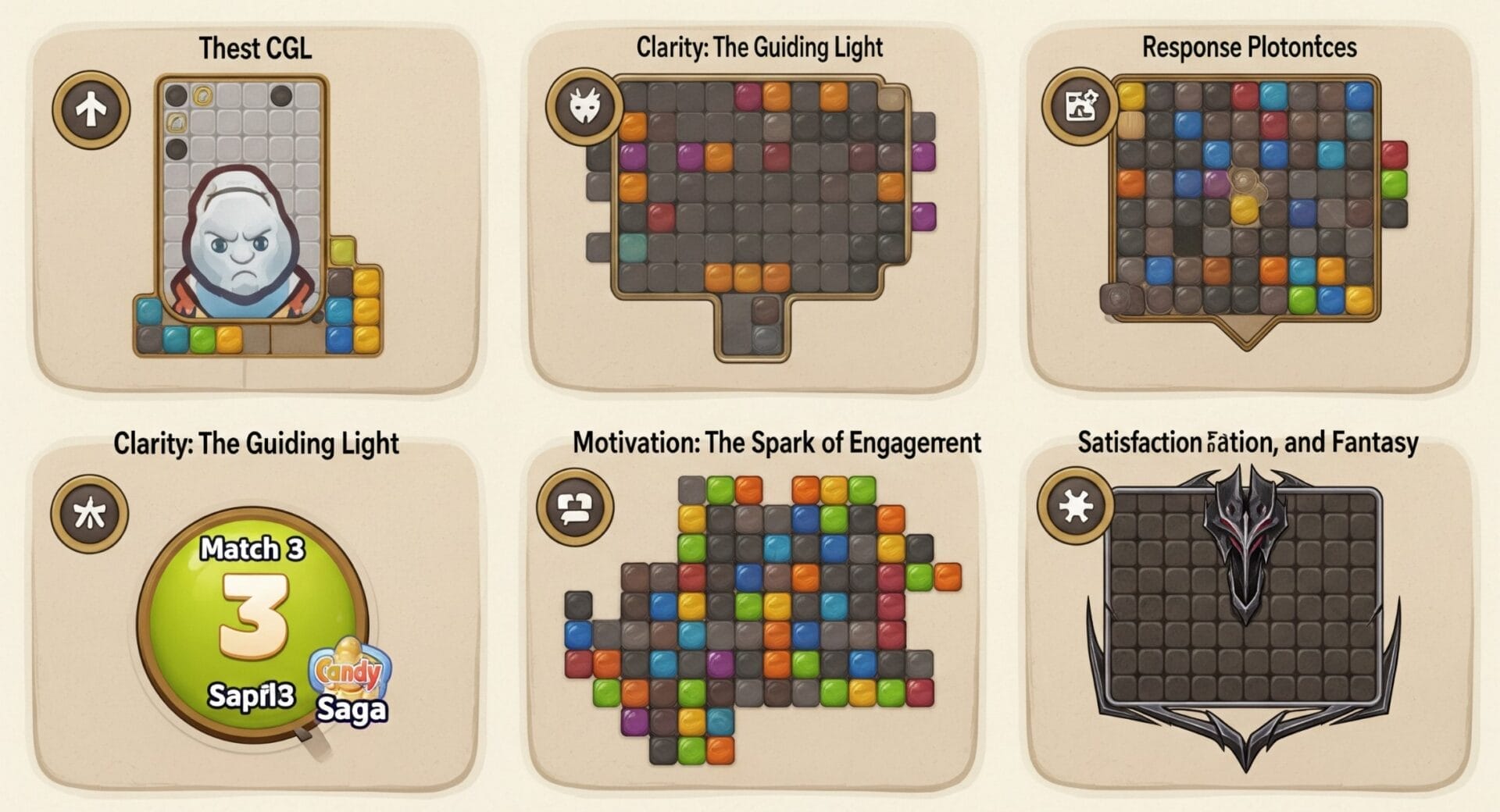
- Design for the Five Pillars: A strong core loop must satisfy the five pillars of Player Centric Game Design: Clarity, Motivation, Response, Satisfaction (Viscerality and Strategy), and Fantasy. These pillars ensure the loop is not only functional but also psychologically resonant and fun.
The Core Loop: A Game’s Beating Heart

The core gameplay loop is the most repeated set of actions and the central gameplay system around which the entire player experience is constructed. It is the essential, repeatable cycle of actions the players engage in that makes up the primary flow of your players experience, keeping them coming back again and again.
For classic games, this core is immediately obvious and irreducible. Think about the original Mario where the loop is the interplay of walking, running, and jumping to overcome an obstacle. In a first-person shooter (FPS), the essential rhythm of gameplay is the constant cycle of aiming, firing, and advancing. This small, repeating cycle, often called the “beating pulse” of the game, defines the game’s identity and its genre.
Why the Core Loop Is Non-Negotiable
A game without a clearly defined and engaging CGL risks becoming a disjointed, “loosely scattered collection of features”. When this happens, players flounder, struggling to find a path that works for them, which leads to frustration and disinterest.
For a development team, establishing the CGL early in the process is not just good practice—it’s a fundamental business imperative. The failure to define this core creates what designers often call “design debt”. This debt often results in a “kitchen sink approach” where the team adds features without a unifying purpose, leading to wasted resources and a disjointed player experience.
We have seen many projects collapse because they lacked a defined core. Clockwork Empires, developed by Gaslamp Games, serves as a historical example of a project that failed to coalesce around a central loop and consequently collapsed under the weight of its own systemic incoherence. More recently, the history of game development provides clear examples of how critical an early, well-defined CGL is for project success and longevity.
Case Studies in Clarity and Collapse
The CGL acts as a blueprint and a guiding vision for the entire development team. It answers the fundamental question: “What is my game about?”.
Success Story: Prison Architect
Introversion Software’s Prison Architect is a prime example of successful loop development. The developers quickly settled on the core mechanics of building and managing a functional prison. They established this CGL early in the game’s Early Access development. Subsequent updates focused solely on refining and expanding this central, well-understood loop. This commitment to the core vision made Prison Architect one of the most successful Early Access titles in recent memory.
Cautionary Tale: Anthem
In contrast, BioWare’s Anthem serves as a sobering cautionary tale. Reports suggest that after more than six years of development, the team had still not finalized a definitive CGL. The project shifted drastically between concepts, cycling from a survival game to a looter-shooter, wasting years of valuable development time and resources. The game’s final core loop was reportedly hastily assembled in the final 12 to 16 months of development. This structural lack of clarity resulted in a product that felt incoherent and unfinished, ultimately leading to its critical and commercial failure.
The Foundational Structures of Engagement
While the CGL describes the essential rhythm of play, designers use specific models to construct that rhythm. The most widely recognized model is the three-stage psychological cycle that underpins engagement.
The Foundational Triad: Challenge, Action, and Reward
The elemental model of the core loop is simple yet incredibly powerful. It describes the basic psychological feedback mechanism that makes play compulsive.
- Challenge: This stage presents the player with an obstacle, task, or problem. It provides the clear impetus for interaction, giving the player an immediate purpose within the game world.
- Action: In response to the challenge, the player performs an action. This is the execution of the game’s core mechanics—the verbs of play, such as shooting, jumping, or crafting. The quality and tactile feel of these actions are paramount, as this is the player’s primary mode of expression.
- Reward: Upon successfully overcoming the challenge and completing the action, the player receives a reward. This payoff reinforces the behavior, encouraging the player to repeat the cycle. Rewards can be intrinsic (the feeling of mastery) or extrinsic (loot, experience points, or narrative advancement).
This triad forms a powerful psychological feedback mechanism. The anticipation of receiving the reward triggers a rush of dopamine in the brain. This dopamine response motivates the player to undertake the action required to overcome the challenge, creating a self-perpetuating cycle of engagement, often referred to as a “compulsion loop”.
The Goal-Oriented OCR Framework
Building upon the psychological triad, the Objective, Challenge, and Reward (OCR) model provides a more structured and design-oriented framework. It reframes the loop by placing an explicit goal at the forefront, offering a clear structure for designers.
- Objective: This is the specific, defined goal the player works toward. Objectives provide direction, transforming a reactive task into a proactive pursuit, such as defeating a boss or reaching a specific point on the map.
- Challenge: In the OCR model, the challenge is defined as the obstacle blocking the path to the objective. This obstacle, be it an enemy group, an environmental puzzle, or a time limit, must be carefully calibrated. It must be difficult enough to provide a genuine sense of accomplishment when overcome, but not so challenging that it causes frustration and abandonment.
- Reward: This is the payoff for achieving the objective. The reward must be significant enough to justify the player’s effort but also carefully balanced so it doesn’t unbalance the game’s progression systems.
While the C-A-R model describes the moment-to-moment “feel” and visceral hook of an action, the OCR model provides a structured framework for implementing that mechanism within the context of levels, quests, and longer gameplay sequences. This dual-lens approach allows for the creation of experiences that are both immediately satisfying and purposefully directed.
Time and Tempo: Layering Nested Loops

A truly engaging game never relies on a single, repetitive loop. Instead, it is built upon an architecture of nested loops operating on multiple timescales, spiraling outward from the core. This layered structure, which creates decisions with consequences across multiple temporal horizons, is the source of the powerful “one more turn” phenomenon.
The Hierarchy of Play: From Nano to Mega
Understanding the hierarchy of loops based on their typical duration and the type of player motivation they elicit is essential for designing satisfying pacing and progression. This structure moves from micro-loops (tactical engagement) to macro-loops (strategic goals).
| Loop Type | Typical Duration | Player Motivation | Example Actions |
|---|---|---|---|
| Nano-Loop | 1–2 seconds | Immediate reaction & precision | Beat Saber: Hit block → Dodge wall |
| Micro-Loop | 5–30 seconds | Fast feedback, moment-to-moment fun | Shooter: Aim → Shoot → Take cover |
| Meta-Loop | 5–15 minutes | Short-term progress & rewards | RPG: Enter dungeon → Clear room → Collect loot |
| Macro-Loop | 1–3 hours | Long-term growth & mastery | Metroidvania: Complete area → Gain new ability → Re-explore old areas |
| Mega-Loop | Days to weeks | Social play & ongoing goals | MMO: Finish story arc → Unlock new expansion → Start new character |
This layered framework helps analyze complex loop structures.
Micro-Loops: The Visceral Fun
Micro-loops (or nano-loops) are the shortest, most frequent actions, lasting only a few seconds. They define the game’s “feel” and tactile experience. Examples include the simple run, jump, and collect coin sequence in a platformer.
The quality of the micro-loop is absolutely paramount. Since players will execute these actions thousands of times, they must be intrinsically enjoyable, relying on responsive controls, clear feedback, and satisfying animations. A weak, unpolished micro-loop cannot be saved by brilliant high-level systems; if the foundational act of play is not fun, the entire game structure built upon it will ultimately collapse.
Macro-Loops: Strategy and Long-Term Goals
On the long-term spectrum, macro-loops and mega-loops represent engagement cycles that can take hours, days, or even weeks to complete. These loops provide the overarching context and motivation for the player’s short-term actions.
For example, a macro-loop might involve completing a major story arc to unlock new content, traveling to a completely new zone to set a new personal goal, or coordinating a large-scale raid with other players in a massively multiplayer online game. These loops are intrinsically linked to progression systems. Their rewards are typically significant: gaining a new level, unlocking a powerful ability, or fundamentally changing the state of the game world. They give meaning to the countless micro-loops that players engage in along the way, transforming individual actions into meaningful steps toward a larger strategic goal.
The Seamless Integration of Tactics and Strategy
The true artistry of game design lies in the seamless integration of these temporal loops. They must connect and feed into one another in a clear, logical hierarchy.
The reward from a micro-loop (e.g., defeating a single enemy) should directly contribute to the completion of a meta-loop (e.g., clearing a room to acquire loot), which, in turn, progresses a macro-loop (e.g., completing a dungeon to gain a level and advance the main story).
This distinction between short and long cycles is fundamentally a distinction between Tactics and Strategy.
- Micro-loops are tactical, focusing on the immediate actions and reactions required to overcome a present challenge.
- Macro-loops are strategic, involving resource management, long-term planning, and overarching goal-setting.
A successful game must engage the player simultaneously on both of these levels. The moment-to-moment actions must be viscerally engaging (good tactics), but they must also serve a larger, meaningful strategic objective.
Avoiding the Grind
When the vital connection between the tactical execution and strategic progress breaks down, players experience the dreaded phenomenon of “grinding”. If the moment-to-moment actions of the micro-loop feel disconnected from meaningful long-term progress in the macro-loop, those actions lose their intrinsic value and become dull, repetitive chores performed merely to advance a progress bar.
To avoid this, the rewards from the micro-loop must be more than just incremental; they must tangibly enable new strategic possibilities in the macro-loop.
For example, when a player defeats an enemy and gathers materials (a micro-loop reward), those materials should allow them to craft a new piece of gear or unlock an ability that enables a new tactical approach in future encounters. This directly impacts their long-term strategic planning. Games like Slay the Spire master this: defeating an enemy (micro-loop) rewards a new card, which immediately alters the player’s strategic options for the remainder of the run (macro-loop). This flow from tactical action to strategic evolution is the hallmark of masterfully designed game.
The Psychology of Sustained Play
A functional core gameplay loop is an engineering feat; a compelling one is a psychological masterpiece. The most successful games are intricately designed engines of engagement, precision-engineered to tap into the fundamental drivers of human motivation. Understanding these principles is essential for creating truly memorable and habit-forming experiences.
The Dopamine Cycle and Habit Formation

The Challenge-Action-Reward structure leverages the brain’s dopamine reward system to create a powerful behavioral mechanism. Dopamine is a neurotransmitter linked to motivation and pleasure. Here is a crucial insight: dopamine is released not when the reward is received, but in anticipation of the reward.
When a player faces a clear challenge and sees the potential for a reward, their brain releases dopamine, driving the motivation to perform the required action. Successfully completing the loop and obtaining the reward reinforces the behavior, making the player more likely to repeat it. This powerful cycle of anticipation, action, and reinforcement is what makes gameplay loops so habit-forming. This cycle is essential for all expensive learning and growth.
Intrinsic vs. Extrinsic Rewards
The rewards driving this psychological cycle are split into two vital categories: intrinsic and extrinsic. The long-term health of a game depends heavily on maintaining the correct balance between these two forms of motivation.
- Intrinsic Motivation: This is the joy derived from the act of playing itself. It’s the satisfaction of solving a complex puzzle, the feeling of mastery after executing a difficult maneuver, or the pure creative expression of building a unique structure. Intrinsic motivation is the bedrock of long-term engagement; it makes a player return because they want to play, not because they feel they have to.
- Extrinsic Motivation: This refers to performing an activity to gain an external reward or avoid punishment. These are tangible incentives like collecting rare loot, earning experience points, climbing a competitive leaderboard, or receiving a daily login bonus. While powerful tools for guiding player behavior, extrinsic rewards carry a significant risk.
An excessive reliance on extrinsic rewards can trigger the “overjustification effect”. When this happens, the external incentive undermines and replaces the player’s intrinsic motivation. Play begins to feel like a chore—a series of tasks completed only for the reward, rather than an enjoyable activity in its own right. A masterfully designed CGL ensures the core action is inherently fun, with extrinsic rewards serving to enhance the experience and guide progression, never acting as the sole reason for playing.
The Flow Channel: Balancing Challenge and Skill
The ultimate state of engagement produced by a compelling core loop is known as “Flow”. The Flow State, named by psychologist Mihaly Csikszentmihalyi, is a condition of complete immersion where the player is energized, fully focused, and enjoying the process. In Flow, the player loses track of time, self-consciousness disappears, and the action feels automatic and effortless.
This optimal experience requires a dynamic and delicate balance between the perceived challenge of the task and the player’s current skill level. This balance creates the “Flow Channel”:
- If the challenge significantly exceeds the player’s skill, it leads directly to Anxiety and frustration.
- If the player’s skill significantly exceeds the challenge, it quickly leads to Boredom and disengagement.
A well-designed CGL is a mechanism for keeping the player within this narrow channel. Since skill naturally increases as a player repeats the loop, the challenge presented by the game must increase in tandem to maintain Flow. This means that elements such as level design, enemy AI behavior, and puzzle complexity are not separate features; they are the primary tools designers use to modulate the challenge component of the loop over time.
Because skill progression varies widely, a one-size-fits-all approach to loop design often fails. Successful games either target a very specific audience (like a hardcore player with a steeper challenge curve) or implement dynamic systems, such as varying difficulty settings or a wide range of content with different challenge levels, that allow the experience to adapt to a broader spectrum of player skills.
The Five Pillars of Player-Centric Design

To ensure a core gameplay loop is psychologically resonant and sustains interest, designers can use the five pillars of the Player Centric Game Design Framework as a practical checklist for evaluation. These are the building blocks of a strong core loop.
- Clarity: Players must intuitively and immediately understand what they are supposed to do and how their actions affect the game state. Ambiguity creates friction and instantly pulls players out of the Flow state. Without clarity, players won’t know how to interact with the game.
- Motivation: Players must have a clear reason to engage with the loop. This motivation might be driven by the inherent fun of the mechanics, the promise of external rewards, or narrative goals. Without motivation, players won’t know where to go next.
- Response: The game must provide immediate, clear, and unambiguous feedback to every player action. This feedback confirms that the player’s inputs have registered and had a tangible effect on the game world. A strong response reinforces the player’s essential sense of control and empowerment.
- Satisfaction: The resolution of the loop must feel genuinely rewarding. Satisfaction has two critical components:
- Viscerality: The emotional and sensory stimulation, the visceral thrill of the experience.
- Strategy: The intellectual gratification of overcoming a mental challenge or executing a complex plan.
- Fantasy: The core actions and goals of the loop must align perfectly with the game’s central theme and the player’s expectations for that specific experience. The loop should empower the player to embody the chosen role—be it a supersoldier, a cunning detective, or a strategic city planner. Without this alignment, they won’t have the experience they came to enjoy.
By systematically evaluating a CGL against these five pillars, designers move beyond simply creating a functional sequence of actions, and instead craft an experience that is engaging, satisfying, and deeply memorable.
A Practical Guide to Designing Your Loop
Designing an effective core gameplay loop is not a singular event. It is a rigorous, iterative process of refinement, ideation, and prototyping. A disciplined, structured approach saves significant time and resources while dramatically increasing the probability of creating a commercially successful game. This design methodology can be broken down into a practical five-step process.
Step 1: Define the Main Loop
The first step requires establishing a clear, high-level vision for the game’s central activity by looking inward at the core fantasy and outward at the existing market.
Analyze the Genre
Start by studying successful games within the target genre. Designers must deconstruct their core loops to understand established player expectations and proven models of engagement. For example, in an RPG, the foundational loop is often Receive Quest → Defeat Enemies → Gain Experience & Loot. This genre analysis provides a foundational chassis to build upon.
Establish the Core Fantasy
Define the essential experience the game must deliver. What role is the player embodying, and what is the central action they are performing? Capture this essence in a short “essence statement”. The essence of Minecraft, for instance, could be simply described as “Explore a vast world to gather resources and use them to build anything you can imagine”.
Formalize the Loop
Based on the genre and fantasy analysis, formalize the main loop as a simple, repeatable sequence of actions. This initial, concise loop must capture the game’s most fundamental interactions. If you were designing a fictional delivery game, the core loop might be Receive Package → Navigate Environment → Deliver Package → Get Paid.
Step 2: Add Sub-Loops to Create Depth
A simple main loop offers necessary clarity, but long-term engagement and depth come from the sub-loops that flesh out each stage of the core cycle. Every step in the main loop can be expanded into its own smaller, detailed cycle of Challenge, Action, and Reward.
Deconstruct Each Stage
Break down each action in the main loop into more granular, smaller interactions. If we look at the “Navigate Environment” stage of the delivery game, this could involve sub-loops for resource management (Monitor Fuel → Find Fuel Station → Refuel) or movement (Jump → Dash → Avoid Obstacle).
Introduce Meaningful Choices
Sub-loops are the key vector for introducing strategic and interesting decisions. Instead of merely navigating, the player now chooses which route to take, whether to engage with an enemy, or how to manage their limited resources. These choices add tactical and strategic layers to the core experience.
Connect Sub-Loops to the Main Loop
Ensure the outcomes of the sub-loops directly impact the main loop. Successfully taking a dangerous shortcut might save critical time but consume significantly more fuel. This risk/reward dynamic adds texture and tension to the core act of delivery.
Step 3: Boost One Step to Define a Unique Selling Proposition
To truly stand out in a saturated market, innovation is often required within an established formula. Designers can achieve this by taking one step of the conventional genre loop and making it exceptionally polished, deep, or unique. This “boosted” step becomes the game’s Unique Selling Proposition (USP).
Identify the opportunity by analyzing the main loop and its sub-loops to find the area with the most potential for innovation, be it the combat system, the progression mechanics, or the narrative delivery. Then, focus development resources on making this single element best-in-class.
For instance, the game Bullets Per Minute takes the familiar shooter loop (Move → Aim → Shoot) and dramatically boosts the “Shoot” step by integrating rhythm game mechanics. This forces players to fire and reload strictly on the beat of the music. This single, profound innovation transforms a familiar experience into something entirely new and memorable. The boosted element should become the central focus of the game’s marketing and communication efforts.
Step 4: Prototype, Analyze, and Improve
A core loop is not created perfectly; it is discovered and refined through rigorous, relentless iteration and prototyping. A prototype is not just a small version of the final game; it is an experiment designed to answer a specific design question, such as “Is this control scheme intuitive?” or “Does this combat encounter feel both challenging and fair?”.
Build a Playable Prototype
As early as possible, the team must create a playable version that allows them to feel the core loop in action. This prototype must focus exclusively on the core mechanics, stripping away all non-essential content, art, or story.
Evaluate and Gather Feedback
Playtest the prototype extensively, both internally with the team and externally with users from the target audience. Designers need to observe player behavior, collecting feedback on whether players understand the goals, if the actions are satisfying, and where they become bored or frustrated.
Iterate Relentlessly
Based on analysis and feedback, make changes and immediately build a new prototype. This cycle of Design → Prototype → Evaluate should be repeated until the core loop feels intuitive, engaging, and robust enough to support the full, final game experience. Prototyping is a critical risk mitigation strategy; it validates design ideas before significant time and resources are committed. It prevents the team from building a larger game on a flawed, fundamental foundation.
Step 5: Leverage the Loop for Marketing and Onboarding
A well-defined core gameplay loop extends its value far beyond the development phase; it is also a powerful asset for marketing and player retention.
Clear Communication
A simple, compelling CGL is remarkably easy to communicate to potential players. It can often be captured in a single gameplay trailer or an animated GIF, instantly conveying the game’s core fantasy and what makes it fun. For example, the loop for Helldivers 2—Choose Gear → Drop In → Complete Objectives → Evacuate—is immediately understandable and clearly communicates the game’s cooperative, mission-based action.
Effective Onboarding
The CGL provides a natural, logical structure for the game’s tutorial. The first-time user experience should focus intensely on teaching the player the main loop, one step at a time, ensuring they grasp the core mechanics before complex, layered systems are introduced. A clear and concise tutorial that quickly guides the player into the core loop is essential for player retention. Studies have shown that a dramatic percentage of players, as high as 85%, do not return after their first day if the core loop is poorly designed.
By following this structured, iterative process, developers can move from a vague idea to a well-defined, highly engaging, and marketable core gameplay loop that provides a solid foundation for the entire game.
Loops in Action: Deconstructing Genre Classics
The abstract principles of the core gameplay loop manifest in distinct and varied ways across different game genres. By examining successful titles, we can identify the specific patterns and priorities that define each genre’s unique experiential signature.
Puzzle Games: The Candy Crush Saga Loop
The core loop of a match-3 puzzle game like Candy Crush Saga is a masterclass in short-session engagement and immediate psychological reinforcement. It is designed for rapid, repeatable satisfaction and broad accessibility.
Core Loop (Micro): The moment-to-moment gameplay is a clear, simple loop: Scan Board for Matches → Swap Gems → Trigger Cascade & Clear Objectives.
- Challenge: The player must identify a potential match of three or more candies that will contribute to the level’s objective.
- Action: The player performs a simple, tactile swipe to swap two adjacent candies.
- Reward: The matched candies are cleared, providing immediate, positive audio and visual feedback. Often, this triggers a cascade of new, unexpected matches. Creating special candies (like wrapped or striped ones) provides a powerful secondary layer of reward, promising more powerful future actions.
This micro-loop is nested within a larger progression loop: Select Level → Complete Level Objective within Move Limit → Earn Stars & Progress on Map. The rewards from the micro-loop directly serve the meta-loop, and the stars earned act as long-term extrinsic motivation for replaying levels. The short, self-contained nature of each level makes this an ideal loop for mobile play sessions.
Strategy Games: The Dual Loop of Clash of Clans
Mid-core strategy games like Clash of Clans utilize a more intricate “dual loop” structure. This structure is specifically designed to encourage two things: very short, frequent check-ins throughout the day, and longer, more strategic play sessions.
- Core Loop 1 (Management): This loop centers on resource management and base building: Collect Resources → Spend Resources on Upgrades/Training → Set New Timers. This loop is fast, rewarding players for frequently opening the app, and provides the resources needed for longer-term goals.
- Core Loop 2 (Combat): This loop focuses on player-versus-player (PvP) combat: Scout Opponent → Deploy Troops → Battle for Resources & Trophies. Successful attacks yield resources and trophies. Crucially, these rewards flow directly back into the first loop, funding the base upgrades.
The complexity of these two interacting loops is contextualized by a persistent “metagame” layer where players spend time planning army compositions, optimizing base layouts, and coordinating with their clan members. The dual loop structure serves this metagame perfectly: the quick management loop brings players back often, and the combat loop provides the competitive impetus to engage deeply with the strategic metagame.
Open-World RPGs: The Witcher 3: Wild Hunt
The core loop of a narrative-driven open-world RPG like The Witcher 3 must seamlessly integrate exploration, combat, and storytelling. The high quality of the game’s writing and storytelling serves to effectively disguise the repetitive nature of the underlying gameplay loop.
Core Loop (Meta): The primary cycle operates at the quest level: Accept Quest → Investigate/Explore → Engage in Combat/Dialogue → Resolve Quest & Receive Reward.
- Challenge: A non-player character presents a problem, ranging from a complicated political dilemma to a monster infestation.
- Action: The player uses a combination of mechanics, including:
- Investigation: Using special “Witcher Senses” to find clues, playing out like a detective story.
- Exploration: Traversing the massive, open world.
- Combat: Engaging in tactical swordplay and magic (“signs”).
- Dialogue: Making significant choices in branching conversations.
- Reward: The player receives loot, currency, and experience points. Most importantly, the primary reward is the narrative progression and seeing the tangible consequences of their choices unfold in the world.
In The Witcher 3, the narrative is not just a wrapper; it is the primary driver. The excellent character writing and morally ambiguous choices provide powerful intrinsic motivation. Players are compelled to engage with the next quest not merely for the extrinsic rewards, but because they desperately want to see what happens next in the story. The smallest decision in a minor side quest can have major repercussions on the game’s world state, ensuring every loop feels meaningful and consequential.
Action-Shooters: DOOM (2016) and Push-Forward Combat
The core loop of DOOM (2016) is a high-octane, aggressive cycle meticulously designed to reward offensive play and force forward momentum. It subverts the common conventions of modern cover-based shooters by making aggression the optimal strategy for survival.
Core Loop (Micro): The combat loop, famously known as “push-forward combat,” is a frantic cycle: Identify Threat → Close Distance → Kill Demon → Collect Resources from Kill → Repeat.
- Challenge: The player faces a complex arena filled with diverse demonic enemies.
- Action: The player aggressively engages enemies at extremely close range, utilizing high-speed movement and a powerful, unique arsenal.
- Reward: The essential linchpin of this loop is the “Glory Kill” system. By staggering an enemy and performing a brutal melee execution, the player is instantly rewarded with a shower of health and ammo pickups. This brilliant mechanic inverts the typical shooter dynamic: when the player is low on health, they are incentivized to charge toward the danger to replenish resources, rather than seeking cover.
This loop fosters a “hunter” style of gameplay, where the player constantly chases the next target to stay alive. This combat micro-loop is nested within a larger exploration loop—Players Clear Combat Arena → Explore Interconnected Level → Find Secrets/Upgrades → Unlock Next Arena. The upgrades found during the exploration phase directly feed back into the combat loop, empowering the player to be even more aggressively successful in the next encounter. This creates a satisfying synergy between intense combat and quieter exploration moments.
Survival and Crafting: The Minecraft Loop
The core loop of a survival game like Minecraft is remarkably simple yet fractal: Explore, Harvest, Craft. This three-stage loop accurately describes the player’s activity across all timescales.
- Moment-to-Moment: The loop describes punching a tree to harvest wood, which is then crafted into a wooden axe.
- Day-to-Day: The loop describes exploring a new biome to find new materials, harvesting large quantities, and bringing the supplies home to craft a complex structure or new piece of gear.
This loop expands naturally. When you start the game, the loop is tightly focused on immediate survival. As the player’s comfort with the basic systems grows, they begin to identify larger landmarks and strike out further into new content, setting self-directed goals. The items crafted (the reward) enable the player to explore new and increasingly dangerous areas (the next challenge), creating powerful, long-term retention.
Time Scales in Practice: World of Warcraft
Alexander Brazie, who worked on World of Warcraft (WoW) as a systems and content designer, uses the massive scale of an MMORPG to demonstrate how loops are layered across time. The game is built on multiple loops, each feeding into the next.
The essential progression loop for WoW works across all four recommended time scales:
| Loop Type | Example Actions in WoW |
|---|---|
| Moment to Moment | 1. Spot Resource/Enemy 2. Face Enemy 3. Evade Attack 4. Defeat Enemy 5. Collect Resource (↻ repeat) |
| Minute to Minute | 1. Spot quest giver 2. Acquire quest 3. Chart path to quest 4. Complete quest 5. Return for reward (↻ repeat) |
| Hour to Hour | 1. Complete quests 2. Craft best gear 3. Adjust spells / talents 4. Sell extra resources (↻ repeat) |
| Day to Day | 1. Travel new zones 2. Set new goals 3. Make new friends 4. Plan for raids 5. Complete PvP (↻ repeat) |
The leftmost column represents the innermost core gameplay, while the rightmost represents the player’s big-picture goals. The success of WoW is in the seamlessness of this integration. The micro-loop reward (collecting a resource or defeating an enemy for experience) directly feeds the minute-to-minute quest completion, which, over an hour, allows the player to craft better gear, which then empowers the player to participate in high-level content like planning for raids (day-to-day).
Alexander Brazie, having designed key content for titles like Burning Crusade (including Black Temple and Karazhan raid bosses) and Wrath of the Lich King (Death Knight talents and the Vehicle system), saw firsthand how these nested progression loops created the remarkable engagement that encouraged players to organize 20–40 people to show up at the same place two or three times a week.
Advanced Strategies and Business Models
A functional CGL is the foundation, but advanced design concepts are necessary to elevate the experience to truly exceptional heights. This includes ensuring narrative coherence and understanding how business models manipulate the loop structure.
Weaving Story and Play: Ludo-Narrative Consistency
The relationship between a game’s story (narrative) and its mechanics (ludo) is critical to its overall coherence. The goal is ludo-narrative consistency, where the actions a player performs within the core loop align with and reinforce the plot and themes of the story. When unified, the player’s immersion is deepened and the experience feels much more meaningful.
- Ludo-Narrative Dissonance: This is the conflict that occurs when the story tells the player one thing, but the gameplay forces them to do another. For instance, a game’s story might present the player character as a reluctant pacifist hero who hates violence, yet the core loop requires the player to massacre hundreds of enemies without consequence.
- The Assassin’s Creed Odyssey Clash: In Assassin’s Creed Odyssey, the realistic historical setting can clash with the character’s magical weapons and superhuman abilities, creating a form of dissonance for some players.
Designers must constantly ask, What is my game about? The answer must be reflected simultaneously in both the core gameplay loop and the story.
The Influence of the Free-to-Play Model
The Free-to-Play (F2P) business model relies on in-app purchases for revenue, which profoundly influences the design of the core gameplay loop. In F2P games, the CGL is designed not just for engagement but also to strategically create opportunities for monetization.
Monetizing Obstruction
A common F2P strategy is to design the CGL with “inconvenient gameplay elements” or “artificial barriers” that deliberately impede the player’s progress. These obstructions might be wait timers for building upgrades, energy systems that restrict the number of actions per session, or difficult levels that can only be easily overcome with purchased consumable power-ups. The game then sells the ability to bypass these obstructions, effectively monetizing the player’s desire for “unobstructed play”.
Designing for Endless Progression
Because F2P games rely on retaining a massive user base over a long period (only 1% to 5% of players ever make a purchase), the core loops and progression systems are designed to be seemingly never-ending. This requires a constant stream of new content, events, and long-term goals to keep players engaged for months or even years.
The integration of monetization into the CGL is a delicate balancing act. If purchases provide too great a gameplay advantage, the game becomes “pay-to-win,” which alienates non-paying players and jeopardizes the fairness of the game. A “fair” approach focuses on selling cosmetic items that do not affect gameplay, or offering purchases that allow players to choose between investing time or money. For example, a puzzle game might allow players to unlock all levels through regular play or offer the option to purchase level packs for immediate access. This respects player choice and avoids making purchases feel absolutely necessary for success.
The Metagame: Strategy Beyond the Core Loop
The metagame is a crucial, often invisible layer of strategic gameplay that exists outside the direct execution of the core loop. It encompasses all the strategic planning, optimization, and theorycrafting that players engage in to improve their performance within the loop.
The metagame is where players are not actively consuming or earning resources, but are staying engaged by optimizing their future progress. In a complex game like League of Legends (a title Alexander Brazie worked on, where he redesigned the Xerath Champion and support income system), the metagame involves planning team compositions, refining build orders, and adapting to community strategies.
The metagame provides the long-term mastery and depth of a game. It allows players to delve deep into strategy, break complex goals into manageable sub-goals, and interact with the community to share tactics. A well-designed game draws players in with an accessible core loop but then slowly reveals layers of strategic depth in the metagame to keep them engaged for the long haul. Hiding this complexity and letting players discover it on their own is key to a successful metagame design.
Avoiding Design Mistakes
Even with a strong foundational model, there are many common pitfalls—or design pathologies—that can lead to an unrewarding, repetitive, or frustrating player experience. Awareness of these potential problems is the first critical step toward avoiding them.
Loop Pacing and Repetitiveness
The Loop Is Too Long
If the basic cycle of action and reward takes too long to complete—more than just a few minutes—players easily lose their sense of progress and become disengaged. This is especially true for mobile games designed for quick play sessions. The CGL must provide a rapid, satisfying payoff to keep motivation levels high.
Lack of Variation
Repeating the exact same actions without any change or evolution will quickly lead to player boredom. A strong CGL is built on a simple, elegant foundation but constantly introduces new challenges, contexts, or mechanics to keep the experience fresh. The core action may remain the same (e.g., shooting), but the situation in which it is performed—new level design, new enemy types with varied behaviors, or new player abilities—must constantly change.
Pacing Problems
A relentless, non-stop, all-action pace can actually lead to player numbness and burnout. Effective pacing requires alternating intense periods of high action with moments of calm. These quieter moments, such as narrative sequences, puzzle-solving, or exploration, allow the player to rest, process their rewards, and plan their next strategic move. Breaking up the core action loop ensures its return feels exciting and fresh.
Reward Structure and Feedback Failures
Unclear or Unrewarding Payoffs
Players must clearly understand exactly what they have earned for completing a loop and why that reward is valuable to their overall progress. If the reward is insignificant, ambiguous, or disconnected from the player’s long-term goals, its motivational power is lost entirely. The reward needs to feel proportional to the effort required to overcome the challenge.
Ignoring Immediate Feedback
Players must feel the results of their actions immediately. A lack of responsive visual, auditory, and haptic feedback makes actions feel sluggish, disconnected, or “clunky”. This directly violates the “Response” pillar of player-centric design, breaking the player’s essential sense of control and immersion.
Structural Failures: Disconnected Systems
Disconnected Loops The moment-to-moment micro-loops must naturally and logically connect to and feed the larger macro-loops of progression. As discussed, a failure to create this hierarchical connection results in grind. The core actions feel meaningless when performed only as a means to advance an unrelated end.
Excessive Complexity While depth is certainly desirable in a long-term game, adding too many disconnected systems or mechanics can increase complexity to the point where the player becomes overwhelmed. A game becomes “clunky” when its various mechanisms do not work together cohesively, making it impossible for the player to form a coherent strategy. Elegance in design often comes from generating a wide possibility space and strategic depth from a small set of interacting rules, rather than relying on a large number of disjointed features.
The Philosophical Debate: Are Loops Manipulative?
There exists a critical school of thought that suggests an overt focus on designing “loops” can be inherently detrimental. This perspective argues that it can lead to manipulative or artificial experiences, rather than organically interesting ones. Critics contend that some of the most memorable games are those that offer immense freedom and interesting mechanics, allowing players to create their own goals and emergent loops, rather than being tightly guided through a pre-designed cycle. The very term “loop” traces its origin to arcade games, where the goal was simply to keep players inserting coins, a market-driven necessity that might not be suitable for all types of video games today.
However, the counterargument is strong: a gameplay loop is an unavoidable, natural, and emergent property of any interactive system. The human brain is wired to find patterns and create its own loops to process experiences. From this viewpoint, a designer’s focus on the CGL is not about trapping the player, but about ensuring that the most frequently repeated patterns of interaction are as intuitive, polished, enjoyable, and satisfying as possible. The CGL provides a clear, essential focus for development efforts, ensuring the foundational core of the experience is strong before the team builds outward. The true danger lies not in the concept of the loop itself, but in designing loops that are hollow, manipulative, or disconnected from genuine, intrinsic player motivation.
Conclusion: The Mastery of Repetition
The core gameplay loop is, without doubt, the fundamental architectural unit of game design. It is the rhythmic heartbeat of play, a recurring and critical cycle of challenge, action, and reward that consistently drives player motivation, engagement, and long-term retention. A truly successful game is never an arbitrary collection of features, but a highly cohesive system of nested loops, where the tactical, moment-to-moment actions are given deep meaning and purpose by the strategic, hour-to-hour goals of the macro-loop.
Effective loop design is a profound multidisciplinary art, skillfully blending the precision of systems engineering with a deep empathy for human psychology. It demands an acute understanding of the brain’s powerful dopamine-driven reward pathways, a careful and deliberate balance between intrinsic satisfaction and extrinsic incentives, and a constant, dynamic effort to maintain the player within the delicate “Flow Channel” where challenge and skill meet in perfect equilibrium. The process of discovering this perfect loop is iterative and demanding, requiring continuous cycles of ideation, prototyping, and rigorous analysis to refine a game’s essential actions until they become intuitive, satisfying, and capable of supporting a complete, compelling experience. This skill is so essential that studios rigorously vet for this ability during the hiring process.
From the rapid-fire satisfaction of a mobile puzzle game like Candy Crush Saga to the sprawling, narrative-driven quests of an open-world RPG like The Witcher 3, the CGL is the essential, defining element that shapes a game’s entire identity. It is both the first impression a game makes and the lasting memory it leaves. Ultimately, mastery of the core gameplay loop is the absolute foundation of professional game design. By focusing intensely on creating a polished, meaningful, and psychologically resonant core, designers can build worlds that not only capture a player’s initial attention but also earn their sustained dedication for years to come.
What is Your Core Loop?
We have explored how the Challenge, Action, and Reward cycle forms the basis of all great games. Now we want to hear from you.
Did you find this deep dive into nested loops and the five pillars helpful? What game do you think has the most perfect core loop, and why? Share your thoughts and questions in the comments below!

Game Developer | Designer | Creative Storyteller
Matt Dogherby is a passionate game developer and designer based in Brisbane, Australia. With a career spanning over 15 years, Matt combines technical skill with a deep love for storytelling to create games that captivate and inspire. His unique perspective is shaped by the laid-back energy of Brisbane and his lifelong connection to the ocean, where he often trades coding sessions for surf sessions.