
game developer vs game designer vs level designer:The Ultimate Guide to Understanding Three Key Game Industry Roles
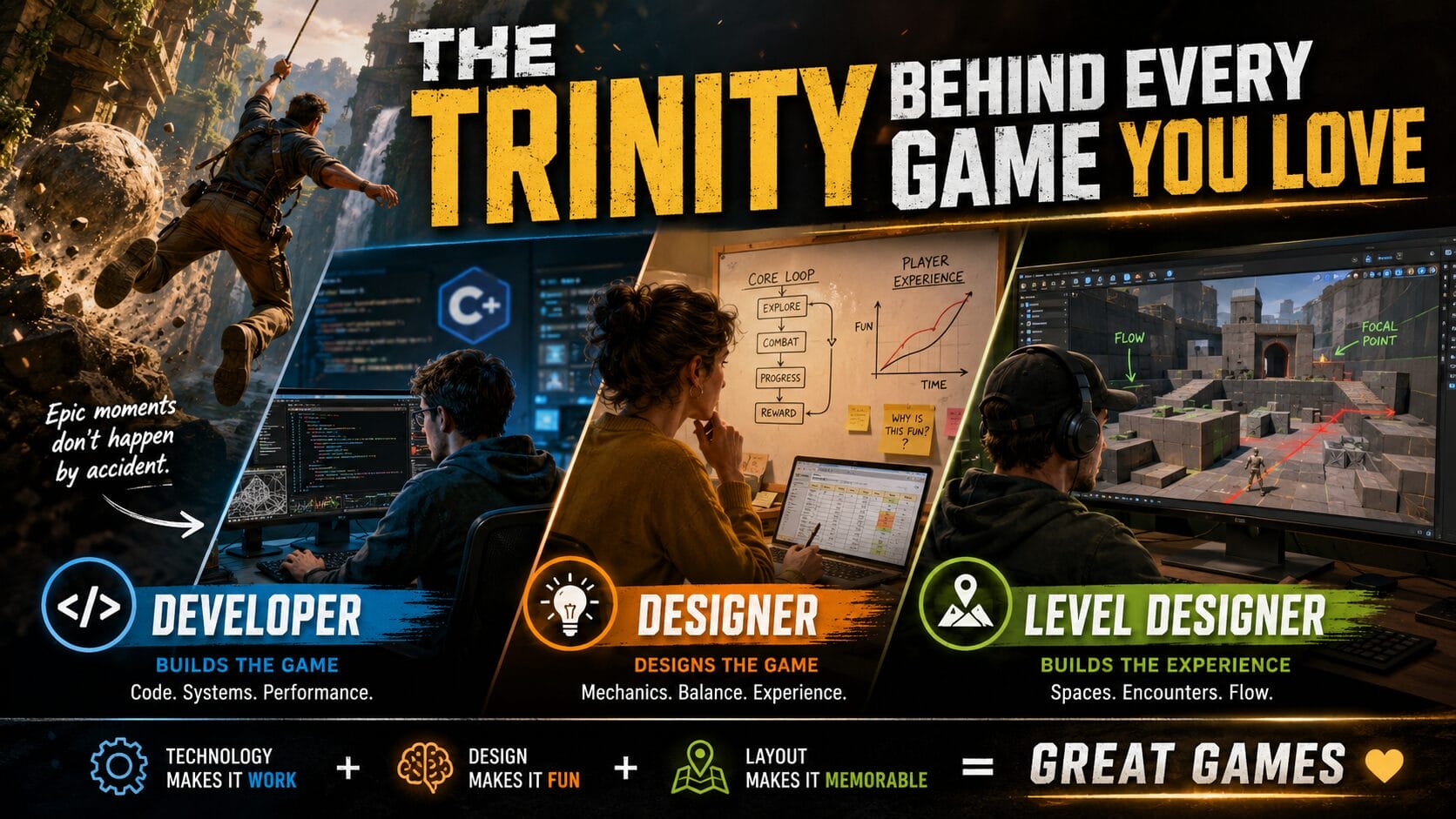
Picture this: you’re sprinting through a crumbling temple in Uncharted, dodging boulders and swinging across chasms, your heart pounding as Nathan Drake quips something about bad luck. Three seconds of gameplay, and three entirely different professions made it possible. The programmer who wrote the physics engine that makes that boulder roll convincingly. The designer who decided that boulders should chase you at all, and that the timing should feel just barely survivable. The level designer who placed every handhold, every ledge, every camera angle so that your escape feels like a cinematic masterpiece rather than a geometry puzzle.
Most people outside the game industry use the terms “game developer,” “game designer,” and “level designer” interchangeably, as though they’re all just different words for “person who makes video games.” But inside a studio, these are radically different jobs with different skill sets, different mindsets, different career trajectories, and, yes, different paychecks. Understanding these distinctions isn’t just academic trivia; it’s essential if you’re considering a career in games, hiring a team, or simply trying to understand why your favorite game’s sequel felt so different from the original.
This guide goes deep into every dimension that separates these three roles: what they actually do day-to-day, the tools they swear by, the skills you need to break in, what they earn, who the legends are in each field, and how they collaborate (and sometimes collide) on real projects. I’ve woven in personal anecdotes from my own journey through the game industry, real-world case studies, and a hefty FAQ section to answer the questions people ask most. By the end, you’ll never confuse a developer with a designer again.
Background: Why the Confusion Exists
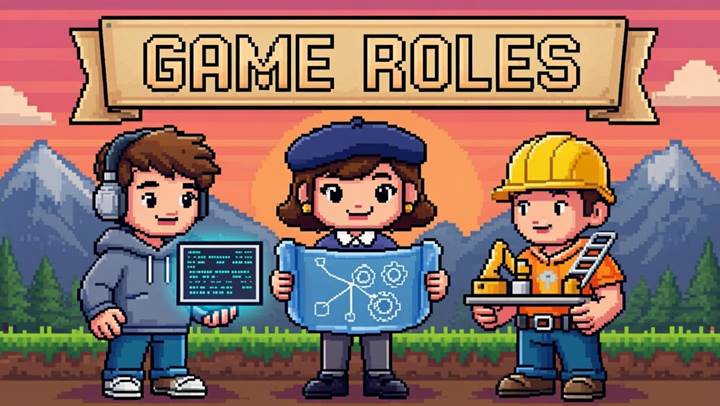
The confusion between these roles starts with the word “developer” itself. In the broadest industry sense, a “game developer” can mean anyone who contributes to making a game, including artists, producers, and yes, designers. Studios are often called “developers” regardless of their team composition. But in day-to-day studio language, “developer” almost always means “programmer”, the person who writes code. This dual meaning creates a fog that obscures the very real differences between coding, designing, and level crafting.
The historical evolution of these roles adds another layer of complexity. In the early days of gaming, the 1970s and 1980s, one person frequently did everything. Shigeru Miyamoto didn’t just design Donkey Kong; he also dictated the programming logic and laid out every level. The programmer was the designer was the level designer was the artist. As games grew more complex through the 1990s and 2000s, specialization became inevitable. Today, a AAA title might employ hundreds of programmers, dozens of designers, and a dedicated army of level designers, each with their own sub-specializations and reporting structures.
Furthermore, the lines blur in indie development, where a team of three or four people might share all three roles simultaneously. Markus “Notch” Persson programmed, designed, and built the levels for the original Minecraft prototype all by himself. This flexibility is beautiful, but it perpetuates the myth that these roles are interchangeable. They’re not. Each requires a distinct cognitive toolkit, and mastering one doesn’t automatically qualify you for another. As the game industry has matured into a global powerhouse worth approximately $188 billion in 2024 according to Newzoo’s market data, the specialization has only deepened.
The Game Developer: The Code Architect

What Does a Game Developer Actually Do?
A game developer, in the specific sense of “game programmer,” is the engineer who writes the code that makes a game function. When your character jumps, a developer wrote the physics calculation that determines the arc. When enemies spot you through a doorway, a developer coded the AI perception system. When you save your game and pick up exactly where you left off, a developer built the serialization system that captures and restores the entire game state. Their output isn’t ideas or layouts; it’s functional, compiled, running code.
On any given day, a game developer might be debugging a memory leak that causes the game to crash after two hours of play, implementing a new rendering technique for realistic water reflections, optimizing the networking code so that 100 players can occupy the same server without lag, or building custom tools in Python that help level designers place objects more efficiently. The work is deeply technical, often frustrating, and immensely satisfying when that obscure bug finally gets squashed and the game runs at a buttery smooth 60 frames per second.
The Developer’s Toolkit
Game developers live inside their IDEs (Integrated Development Environments) and game engines. The most common programming languages in game development are C++ for AAA engines like Unreal Engine and proprietary studio engines, C# for Unity-based games, and Python for tooling, scripting, and build pipelines. According to Coursera’s game development resources, C++ remains the gold standard for performance-critical game code, while C# dominates the indie and mobile space through Unity.
- Game Engines: Unreal Engine, Unity, Godot, CryEngine, and proprietary studio engines
- IDEs: Visual Studio, VS Code, Rider, CLion
- Version Control: Git, Perforce (Helix Core) for large binary assets, SVN
- Debugging & Profiling: RenderDoc, PIX, Unreal Insights, Unity Profiler
- Graphics Programming: HLSL/GLSL shader development
- Build & CI: Jenkins, TeamCity, Unreal Build System
Essential Skills for Game Developers
Beyond raw programming ability, game developers need a solid foundation in mathematics, particularly linear algebra for 3D transformations, calculus for physics simulations, and discrete mathematics for game logic and AI algorithms. They must understand software engineering principles like design patterns, clean architecture, and agile methodologies. The ability to read and optimize existing codebases is crucial, since game projects often span years and multiple generations of programmers contribute to the same code.
Soft skills matter enormously too. A developer who can’t communicate with designers about technical constraints will create friction that slows the entire team. I’ve witnessed brilliant programmers who could write a custom physics solver in their sleep but couldn’t explain to a designer why the double-jump mechanic they wanted would require three weeks of refactoring. The best developers I’ve worked with could translate between “I want it to feel floaty but responsive” and “I need to adjust the gravity constant and add a coyote-time buffer” without missing a beat.
Career Path and Salary
The typical career path for a game developer starts with a Bachelor’s degree in Computer Science or a related field, though a strong portfolio of shipped projects can sometimes substitute. Junior programmers typically earn between $50,000 and $75,000 per year in the US, while senior developers can command $110,000 to $157,000 or more, according to Glassdoor salary data which reports an average of around $96,814. The Bureau of Labor Statistics projects 15% growth for software developers from 2024 to 2034, much faster than the average for all occupations, though game-specific roles can be more volatile.
Career progression typically follows: Junior Programmer to Programmer to Senior Programmer to Lead Programmer to Technical Director or CTO. Along the way, developers often specialize into sub-roles like Gameplay Programmer, Engine Programmer, AI Programmer, Network Programmer, Tools Programmer, or Graphics Programmer. Each specialization has its own depth and demand. Graphics programmers, for instance, are among the highest-paid in the industry because their skills are transferable to film, simulation, and emerging fields like VR/AR.
The Game Designer: The Creative Architect

What Does a Game Designer Actually Do?
If the developer is the engineer who builds the house, the game designer is the architect who draws the blueprints and the interior designer who decides how each room should feel. A game designer defines how the game plays: its mechanics, rules, systems, economies, progression, difficulty curves, and overall player experience. They don’t write the code that makes a jump happen, but they decide how high the jump should be, whether the player can double-jump, and how jumping integrates with other systems like combat and traversal.
On a typical day, a game designer might be writing a design document for a new feature, balancing weapon damage values in a massive Excel spreadsheet, playtesting a prototype and noting that the difficulty spikes too sharply in level three, presenting a new system concept to the team with a mockup in Photoshop, or debating with a programmer about whether a proposed mechanic is feasible within the engine’s constraints. Their work lives at the intersection of creativity, psychology, and systems thinking.
The Designer’s Toolkit
Game designers use a different set of tools than developers, reflecting their focus on communication, prototyping, and data analysis rather than raw code. They need enough engine proficiency to build rough prototypes, but their primary instruments are documents, spreadsheets, and diagramming tools.
- Documentation: Google Docs/Sheets, Confluence, Notion for design documents and wikis
- Prototyping: Unity, Unreal Engine (Blueprints), Twine for narrative prototypes, Machinations for economy simulation
- Diagramming: Miro, Lucidchart, Draw.io for flowcharts and system diagrams
- Image Editing: Adobe Photoshop, Illustrator for mockups and concept communication
- Data Analysis: Excel/Google Sheets for balancing, loot tables, and progression curves; basic SQL for querying player data
- Project Management: Jira, Trello, Codecks for tracking features and bugs
Essential Skills for Game Designers
The most underrated skill in game design is communication. A designer’s ideas are worthless if they can’t articulate them clearly enough for programmers to implement and artists to visualize. According to CG Spectrum’s guide on game designer skills, the ability to write clear, unambiguous design documents and present ideas persuasively to stakeholders is as important as creative vision. Designers must also possess systems thinking, the ability to see how individual mechanics interact and create emergent behavior. Change the reload time of a weapon by half a second, and you’ve just altered the entire pacing of combat encounters across the whole game.
Player empathy is another crucial and often overlooked design skill. The best designers can set aside their own expertise and experience the game as a new player would. They understand that what seems obvious to someone who’s played the game for 500 hours might be utterly baffling to someone picking up the controller for the first time. Data analysis skills have become increasingly important as well; live-service games generate mountains of player behavior data, and designers must interpret this data to make informed decisions about balance changes and feature priorities.
Career Path and Salary
Game designers enter the profession through diverse routes. While a Bachelor’s degree in Game Design, Interactive Media, or Computer Science is common and 74% of game designers hold one according to Zippia data, there is no strict formal requirement. Many successful designers entered through QA testing, demonstrating design thinking from the testing role until they earned a promotion. Others came through modding communities, building total conversion mods for games like Skyrim or Counter-Strike that served as living portfolios.
Salary ranges for game designers tend to be lower than developers, reflecting the higher supply of aspiring designers and the perception that design skills are less technically specialized. According to Coursera and Glassdoor data, the median salary is approximately $84,000, with entry-level positions paying $45,000 to $69,000 and senior designers earning $111,000 to $131,000. Career progression follows: Junior Designer to Game Designer to Senior Designer to Lead Designer to Creative Director or Game Director. Along the way, designers often specialize into Systems Designer, Narrative Designer, Combat Designer, UX Designer, or Economy/Monetization Designer.
The Level Designer: The Spatial Storyteller
What Does a Level Designer Actually Do?
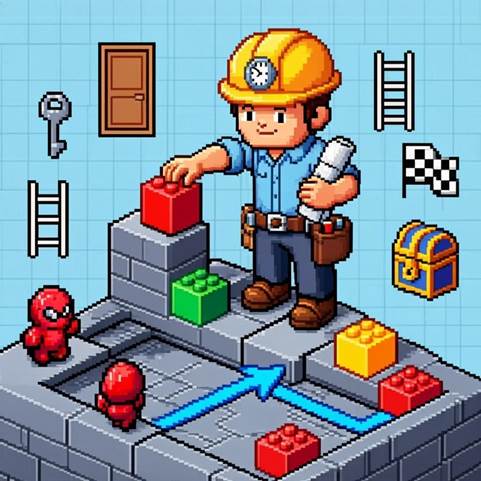
A level designer is a specialized game designer who focuses on the architecture, layout, and gameplay flow of individual game levels or environments. They decide where the player enters, what path they take, where enemies appear, where items are placed, how difficulty ramps within a level, and where the dramatic moments happen. If the game designer defines the rules of chess, the level designer designs each specific board layout that makes those rules shine.
The level design process typically begins with greyboxing or blockmeshing, creating the level out of simple grey geometry to test the flow and pacing before any art is applied. This is where level designers earn their keep: they must be able to make a level feel fun and engaging even when every surface is an untextured grey box. Only after the gameplay flow is validated do environment artists dress the level with final art assets. A level designer also scripts events, sequences, and in-level narratives, places enemies and items, and iterates constantly based on playtest feedback.
The Level Designer’s Toolkit
Level designers are the most engine-dependent of the three roles. Their primary workspace is the level editor within a game engine, which is why proficiency in at least one major engine, usually Unreal Engine or Unity, is essential.
- Level Editors: Unreal Engine Level Editor, Unity Editor, Hammer (Source engine), Radiant, Tiled (2D)
- 3D Blockout: Blender, 3ds Max for creating greybox placeholder assets
- 2D Layout: Photoshop, Illustrator for top-down maps and flow diagrams
- Scripting: Blueprints (Unreal), Visual Scripting (Unity) for events, triggers, and sequences
- Reference: Google Earth, Pinterest for architectural and environmental reference imagery
- Performance: Understanding of occlusion culling, draw calls, level streaming, and LOD systems
Essential Skills for Level Designers
Spatial reasoning is the level designer’s superpower. Where a systems designer thinks in terms of numbers and relationships, a level designer thinks in terms of space, distance, sightlines, and movement. They need to understand how players navigate 3D environments, how architecture guides or misleads, and how the physical layout of a space creates emotional responses. A narrow corridor creates tension. A wide-open vista creates awe. A series of low walls creates opportunities for tactical cover. According to CG Spectrum’s level designer career guide, these spatial thinking skills, combined with player psychology and flow theory, form the core of level design competency.
Level designers also need a unique blend of creative and technical skills. They must be creative enough to design memorable spaces that tell stories through architecture, yet technical enough to work within engine constraints, optimize for performance, and communicate effectively with both environment artists and programmers. I once watched a level designer spend an entire afternoon adjusting the position of a single pillar by inches, testing and retesting how it affected the player’s sightline as they rounded a corner. That level of obsessive attention to spatial detail is what separates good level design from great level design.
Career Path and Salary
Level design is perhaps the most portfolio-driven of the three roles. While 75% of level designers hold a Bachelor’s degree according to Zippia, with common majors including Game Design, Graphic Design, and Game Art, studios hire level designers based almost entirely on the quality of their playable levels and maps. The modding community has historically been the primary pipeline for level design talent. John Romero, perhaps the most famous level designer in history, got his start creating maps for existing games before joining id Software.
Salary data for level designers shows wider variance than the other two roles, partly because “level designer” titles are sometimes folded into broader “designer” categories. Glassdoor reports an average of $69,725, while ZipRecruiter reports $108,658, and PayScale reports $78,108 with a range from $44,000 to $148,000. Entry-level positions typically pay around $60,300 with mid-career at $84,500. Career progression follows: Junior Level Designer to Level Designer to Senior Level Designer to Lead Level Designer to World Director or Content Director.
Key Differences: The Head-to-Head Comparison
Now that we’ve explored each role in depth, let’s put them side by side. The comparison matrix below captures the essential differences across the dimensions that matter most: focus, output, mindset, and more. Understanding these distinctions is crucial whether you’re choosing a career path, building a team, or simply trying to figure out who to blame when a game feature doesn’t work as expected.
| Dimension | Game Developer | Game Designer | Level Designer |
| Primary Focus | Building the game (code/engine) | Designing the game (mechanics/systems) | Designing individual levels/spaces |
| Core Output | Functional, playable code | Design docs, prototypes, balance | Levels, maps, encounters |
| Technical Depth | Very high (programming) | Moderate (prototyping/scripting) | Moderate-High (engine editors, scripting) |
| Creative Scope | Implements others’ vision | Defines the creative vision | Realizes vision within a space |
| Mindset | “How do I build this?” | “What should we build and why?” | “How does the player experience this space?” |
| Avg. Salary (US) | $96,814 – $100,250 | $84,000 – $90,270 | $69,725 – $108,658 |
| Key Tools | IDEs, C++, Debuggers | Docs, Spreadsheets, Prototyping | Level Editors, 3D Blockout, Scripting |
Where They Overlap
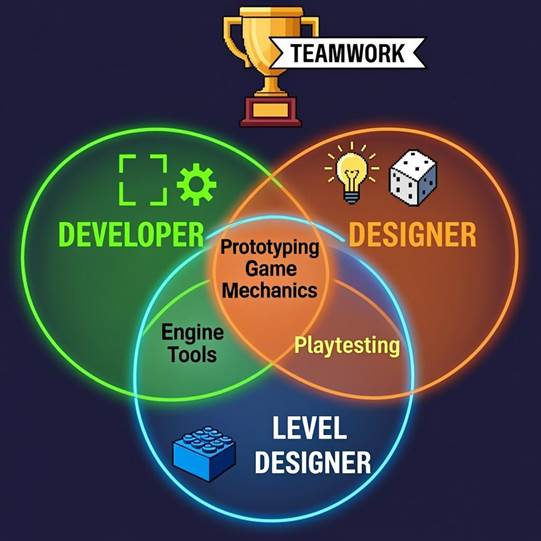
Despite their differences, these three roles share significant common ground. All three use game engines like Unreal and Unity, though they use them differently: developers code in them, designers prototype in them, and level designers build worlds in them. All three participate in playtesting, though they evaluate different things: developers test for bugs and performance, designers test for fun and balance, and level designers test for flow and pacing. In indie studios, one person frequently wears all three hats, which is both a testament to the overlap and a recipe for burnout.
Where They Diverge
The divergences are stark. Developers are engineers first; they may never touch level layout or game balance in their entire career. Game designers think about the whole game system, the interconnected web of mechanics and progression, while level designers think about a specific slice of it, the architecture of a particular dungeon or the pacing of a specific mission. Level designers need spatial and architectural thinking that neither developers nor system designers necessarily possess. And there’s a persistent salary gap: developers typically earn more due to the higher market demand for engineering skills, while designers and level designers earn less on average despite their equally crucial creative contributions.
Real-World Use Cases and Examples
Use Case 1: Building a Double-Jump Mechanic
Imagine a studio wants to add a double-jump to their 3D platformer. The game designer defines the feature: “The player can jump again while airborne, but only once. The second jump should be slightly shorter than the first to prevent sequence-breaking. The double-jump should have a different animation and a small cooldown to prevent spamming.” They write this up in a feature specification document, complete with mockups and edge cases.
The game developer then implements the code. They modify the character controller to track jump state, add a boolean for “hasDoubleJumped,” adjust the physics calculation for the second jump’s reduced height, create the animation state machine transitions, and hook up input handling. They might also add the cooldown timer and ensure the mechanic works correctly with other systems like wall-sliding and gliding. This typically takes two to five days depending on the existing codebase.
The level designer then integrates the new mechanic into existing and upcoming levels. They identify places where double-jump opens new optional paths, redesign sections that were previously too easy because the player can now reach higher platforms, and create dedicated “tutorial” encounters that teach the player when and how to use double-jump. This is where the three-way collaboration becomes most visible: the designer’s vision, the developer’s implementation, and the level designer’s spatial application all must align for the feature to feel good.
Use Case 2: Designing a Boss Encounter
For a boss encounter in an action RPG, the game designer creates the boss’s core identity: its attack patterns, health phases, weakness mechanics, and how it fits into the game’s overall difficulty curve. They might specify that the boss has three phases, with each phase introducing one new attack, and that the player should ideally defeat it in three to five attempts on normal difficulty.
The game developer builds the boss’s AI behavior tree, implements each attack pattern with proper hitboxes and timing, creates the phase transition logic, and ensures the boss interacts correctly with all player abilities. They also optimize the encounter so that all the visual effects don’t tank the frame rate when the boss unleashes its ultimate attack with fifty particle effects on screen simultaneously.
The level designer designs the arena itself: its size and shape, the cover positions available, environmental hazards, and how the space evolves during the fight (perhaps the floor crumbles away in phase two, shrinking the playable area). They place the boss spawn point, define the player’s entry trajectory, and ensure the camera framing makes the boss look as imposing as intended. The level designer’s arena design can make or break a boss fight; even the most mechanically interesting boss feels wrong in a space that’s too cramped or too open.
Use Case 3: Creating an Indie Game Solo
In indie development, the boundaries between these roles dissolve entirely. When Markus “Notch” Persson created the original Minecraft prototype in 2009, he was simultaneously the developer (writing the Java code for the voxel engine and world generation), the game designer (defining the core loop of mine-craft-explore-survive), and the level designer (programming the procedural generation algorithms that create each world’s terrain, caves, and structures). This is common in indie games and game jams, where small teams must wear every hat.
However, even solo developers tend to gravitate toward one role over time. Notch eventually brought in Jens “Jeb” Bergensten to take over as lead developer of Minecraft so he could focus more on design direction. The lesson here is that while one person can do all three jobs, sustained excellence in all three simultaneously is nearly impossible. The cognitive demands are simply too different. As an indie developer friend once told me, “I can code for twelve hours straight, but after two hours of design iteration, my brain is soup.”
Personal Anecdotes: Lessons from the Trenches
The Bug That Taught Me Empathy
Early in my career, I was working as a junior gameplay programmer on a third-person action game. A level designer had built this incredible rooftop chase sequence where the player leaps between buildings, slides down sloped roofs, and barely catches a ledge at the end. It was one of the most thrilling moments in the game. But there was a bug: occasionally, the player would phase right through a roof and fall into the void below. I spent three days tracking it down, and it turned out to be a floating-point precision issue with the collision detection when the player’s velocity exceeded a certain threshold during the slide.
The level designer was frustrated with me for taking so long. “Can’t you just make it work?” they asked. I tried to explain the difference between discrete and continuous collision detection, but their eyes glazed over. It wasn’t until I showed them a visual debug mode with the collision rays rendered on screen that they understood. That moment taught me two things: first, that visual communication bridges the gap between disciplines better than verbal explanation ever will. Second, that developers need to develop genuine empathy for what their colleagues are trying to achieve creatively, not just technically. That rooftop chase was the level designer’s baby, and my bug was killing it.
The Spreadsheet That Saved a Game
On another project, our lead designer spent weeks building a weapon balance spreadsheet for a competitive multiplayer shooter. Every weapon had dozens of variables: damage, fire rate, reload time, magazine size, recoil pattern, bullet spread, range falloff, and more. The spreadsheet was a masterpiece of interconnected formulas and conditional formatting that would turn cells red when a weapon’s theoretical DPS exceeded acceptable bounds. When the game launched, players discovered an exploit where combining two specific weapons created a damage loop that made one player effectively invincible.
The community exploded. The forums were on fire. Our lead designer calmly opened the spreadsheet, traced the interaction between the two weapons’ special properties (one granted a temporary damage boost on kill, the other had a faster kill-reset mechanic than the spreadsheet had accounted for), adjusted three values, and the problem was solved in the next patch. That experience cemented my respect for the invisible art of systems design. The players never saw the spreadsheet, but it was the invisible foundation that held the entire game together.
The Level That Made Me Cry
I once playtested a level for a narrative-adventure game where the player explores an abandoned house, uncovering the story of a family that had fallen apart. The level designer had placed environmental storytelling elements with surgical precision: a child’s drawing stuck to the refrigerator, a half-packed suitcase by the door, a phone with an unsent text message on the nightstand. No cutscenes, no dialogue, just objects in space telling a story through their placement. I found myself genuinely moved, and when I told the level designer, they smiled and said, “That’s what I do. I make spaces that speak.” It was one of the most powerful reminders that level design isn’t just about gameplay; it’s about creating spaces that make people feel something.
Legends of the Craft: Famous Examples
Legendary Game Developers
John Carmack is the quintessential game developer. As co-founder of id Software and the principal programmer behind Doom, Quake, and Wolfenstein 3D, Carmack pioneered 3D engine technology that defined an entire generation of games. His famous “it works” principle, prioritizing functional, efficient code over elegant abstractions, became a guiding philosophy for game programmers worldwide. Tim Sweeney, founder of Epic Games, similarly transformed the industry by building the Unreal Engine, a tool that now powers thousands of games and has become the backbone of modern game development. As documented in
Wikipedia’s list of video game industry people
Legendary Game Designers
Shigeru Miyamoto is widely regarded as the father of modern video games. As the creator of Super Mario Bros., The Legend of Zelda, and Donkey Kong, Miyamoto defined what it means for a game to “feel” right. His design philosophy, rooted in finding joy in everyday experiences and translating that into interactive play, has influenced every game designer who followed. Sid Meier put his name on the box with Civilization, creating the 4X strategy genre. Hidetaka Miyazaki defined the “Soulslike” genre with Dark Souls and Elden Ring, proving that difficulty itself could be a design virtue. According to
Business Pundit’s top video game creators
Legendary Level Designers
John Romero is arguably the most famous level designer in history. His maps for Doom and Quake established principles of level design that are still taught in game design programs today: varied pacing, environmental storytelling through architecture, and the concept of “combat puzzles” where the arrangement of space is as important as the enemies within it. Kim Swift co-created Narbacular Drop as a student project, which was then developed into Portal at Valve. The portal mechanic, and the levels that taught players to use it without a single tutorial prompt, is a masterclass in level design as education. As the
Level Design Book’s history of the level designer
Team Dynamics: How They Work Together
Understanding how these three roles interact is essential for grasping why games turn out the way they do. In a typical AAA studio, the team is organized into disciplines (programming, design, art, audio, QA) coordinated by a producer or project manager. Each discipline has leads who communicate across teams, and the quality of this cross-discipline communication often determines whether a game succeeds or fails.
Designer to Developer: The Vision-Implementation Loop
The most critical dynamic in game development is the loop between designers and developers. A designer creates a feature specification describing what a mechanic should do and how it should feel. The developer implements it in code, often discovering technical constraints the designer hadn’t considered. The designer playtests the implementation and provides feedback. The developer iterates. This loop can repeat dozens of times for a single feature, and the best features emerge from a genuine partnership rather than a client-contractor relationship.
The most common friction point is scope. Designers, by nature, want to add more features, more complexity, more “wouldn’t it be cool if” moments. Developers must manage scope and technical debt, ensuring that the codebase remains maintainable and performant. A wise lead designer once told me, “The hardest part of my job isn’t coming up with ideas; it’s choosing which ideas to kill.” A wise lead developer replied, “And the hardest part of mine is explaining why your surviving ideas take twice as long as you think they will.”
Level Designer: The Bridge Between Disciplines
Level designers occupy a unique position as the bridge between systems design and environment art. They take the mechanics defined by game designers and apply them within specific spaces, then collaborate with environment artists to dress those spaces with beautiful visuals without sacrificing gameplay readability. This constant negotiation between “playable” and “pretty” is one of the most important dynamics in game development. The level designer must fight for the player’s ability to read the space clearly, while the environment artist fights for visual fidelity and atmosphere. The best games find a synthesis where beauty and function enhance each other rather than competing.
Counterarguments and Limitations
Aren’t These Roles Just Arbitrary Labels?
Some industry veterans argue that the boundaries between these roles are more porous than this guide suggests, and they have a point. In practice, game designers often write scripts and do light programming. Level designers frequently make design decisions about mechanics and systems. Developers sometimes propose design changes when they discover that a simpler approach would be more elegant or performant. The labels are tools for organizing teams and careers, not rigid cages. However, the existence of overlap doesn’t negate the fundamental differences in training, focus, and expertise. A designer who can script in Blueprints is not a programmer in the same way as someone who can write a custom rendering pipeline in C++.
The Indie Reality: One Person, Three Hats
The most significant limitation of this role-based analysis is that it describes the AAA studio model. In indie development, the distinctions collapse. Solo developers must be designer, level designer, and programmer simultaneously. Small teams of three to five people share all three roles fluidly. This is both the great freedom and the great burden of indie development. The roles described here are most relevant for studios with twenty or more people, where specialization is necessary to produce the scale of content that modern games demand. As the game industry continues to evolve, we may see further blurring of these boundaries, especially as AI tools make individual contributors more productive across disciplines.
Industry Volatility and Job Security
It would be irresponsible to discuss career paths in the game industry without acknowledging the current volatility. Since 2022, an estimated 40,000 roles have been shed across the industry through layoffs and studio closures, according to the 2025 Global Gaming Employment Outlook report. Twenty-six percent of game professionals experienced layoffs in the past year, and thirty-nine percent of junior-level workers exited the industry entirely in 2024-2025. Despite this turbulence, over 109,000 gaming jobs were posted in 2025, reflecting sustained demand for experienced talent. Entry-level positions remain extremely competitive, and the career paths described in this guide require persistence, continuous skill development, and a healthy dose of resilience.
game developer vs game designer vs level designer Frequently Asked Questions
Q: Can a game developer also be a game designer?
Absolutely, especially in indie development. Many developers have strong design sensibilities and create their own games from scratch. However, in larger studios, the roles typically separate because each requires deep specialization. A developer who wants to move into design usually needs to demonstrate design thinking through side projects, game jam entries, or internal prototypes. The reverse transition, from designer to developer, is less common because it requires substantial programming skills that take years to develop.
Q: Which role pays the most?
Game developers (programmers) typically earn the highest salaries due to the strong market demand for software engineering skills. Average salaries range from $96,814 to $100,250, compared to $84,000 to $90,270 for game designers and $69,725 to $108,658 for level designers. However, senior designers and creative directors at top studios can earn well over $150,000, and successful indie developers can earn unlimited upside from their own titles.
Q: Do I need a degree to work in games?
Not strictly, but it helps significantly. Approximately 74-75% of professionals in all three roles hold Bachelor’s degrees. For game developers, a Computer Science degree is strongly preferred by AAA studios. For designers and level designers, portfolios matter more than degrees, but a degree provides structured learning, networking opportunities, and a safety net if the game industry doesn’t work out. Self-taught routes exist and have produced many successful professionals, particularly through modding communities and online courses.
Q: What’s the best way to get started in level design?
Start modding. Create custom maps for games with active modding communities like Counter-Strike 2, Skyrim, Doom, or Minecraft. Build a portfolio of playable levels that demonstrate your understanding of pacing, flow, and player guidance. Join communities like Mapcore where level designers share work and feedback. Apply for junior level designer positions with your portfolio. Many of the industry’s best level designers, including John Romero and Kim Swift, entered through modding or student projects.
Q: Is game design just about coming up with ideas?
This is one of the most persistent misconceptions in the industry. Everyone has ideas; designers are valuable because they can execute on ideas, evaluate them objectively, and refine them through iteration. Game design involves rigorous systems thinking, extensive documentation, data analysis, playtesting, and communication. A designer who just “comes up with ideas” without the skills to specify, prototype, and iterate on them is not employable. As the saying goes: “Ideas are cheap. Execution is everything.”
Q: Can AI replace these roles?
AI is augmenting all three roles rather than replacing them. AI coding assistants help developers write and debug code faster. AI tools can generate level layouts or suggest design balances. But the creative judgment, player empathy, and interdisciplinary collaboration that define these roles remain uniquely human. The designers who will thrive are those who learn to use AI as a tool while maintaining the creative vision and critical thinking that machines cannot replicate.
Q: Which role has the best job security?
Game developers (programmers) generally have the best job security because their skills are transferable outside the game industry to software engineering, web development, fintech, and other tech sectors. Game designers and level designers have more specialized skills that are harder to transfer, making them more vulnerable during industry downturns. However, experienced designers with strong track records of shipped titles are always in demand, and the best job security in any creative field comes from continuously developing your craft and building a network.
Q: How do these roles differ in mobile vs. PC/console development?
The core distinctions remain the same, but the emphasis shifts. Mobile game development often uses higher-level tools and scripting (Unity/C# rather than custom C++ engines), so developers may work closer to the design surface. Mobile games tend to emphasize systems design (economy, monetization, retention) over level design, since many mobile games are endless or procedurally generated. PC and console games typically have larger level design teams creating handcrafted, narrative-driven spaces. The tools and scale differ, but the fundamental roles remain recognizable.
Conclusion: Three Roles, One Game
The game industry is a collaborative art form, and no single role can create a great game alone. The developer builds the foundation with code, the designer shapes the experience with systems and mechanics, and the level designer crafts the spaces where players live those experiences. Understanding the differences between these roles isn’t just an academic exercise; it’s the first step toward finding your own place in this extraordinary industry, whether you’re drawn to the elegant logic of programming, the creative challenge of design, or the spatial artistry of level crafting.
As the game industry continues to evolve, driven by new technologies, changing player expectations, and the ongoing push-pull between specialization and generalization, the boundaries between these roles will continue to shift. AI tools will augment all three disciplines. Indie development will continue to blur the lines. New sub-specializations will emerge. But the fundamental truth will remain: making games requires builders, dreamers, and architects, and the magic happens when they work together with mutual respect and shared purpose.
If you’re considering a career in games, take the time to explore all three paths. Write code. Design systems. Build levels. You’ll discover which one makes you lose track of time, which one makes your brain light up, which one feels like play rather than work. That’s your role. Now go make something amazing.
References
[1] Game Design Skills – Game Designer vs Game Developer
[2] Champlain College – Game Design vs Game Development
[3] Artemisia College – Game Developer vs Designer Differences
[4] Game Developer – Types of Designers
[5] CG Spectrum – Skills You Need as a Game Designer
[6] ComputerScience.org – How to Become a Video Game Designer
[7] CG Spectrum – Level Designer Career Pathway
[8] Level Design Book – History of the Level Designer
[9] Coursera – Programming Languages for Game Development
[10] Glassdoor – Game Developer Salary
[11] Coursera – Video Game Developer Salary
[12] Coursera – Video Game Designer Salary
[13] CareerExplorer – Game Designer Salary
[14] PayScale – Level Designer Salary
[15] GDC – US Game Development Salaries in 2025
[16] BLS – Software Developers Occupational Outlook
[17] Combine GR – 2025 Global Gaming Employment Outlook
[18] Coursera – How to Become a Game Developer
[19] WGU – Video Game Developer Career Guide
[20] Champlain College – How to Become a Game Designer
[21] Indeed – How to Become a Video Game Level Designer
[22] Upwork – Game Designer vs Game Developer
[23] Wikipedia – List of Video Game Industry People
[24] Business Pundit – Most Successful Video Game Creators
[25] David Mullich – Roles on a Game Development Team
[26] GamesIndustry.biz – Game Development Pipelines
[27] Machinations – 9 Game Design Tools
[28] Zippia – Level Designer Education

Game Developer | Designer | Creative Storyteller
Matt Dogherby is a passionate game developer and designer based in Brisbane, Australia. With a career spanning over 15 years, Matt combines technical skill with a deep love for storytelling to create games that captivate and inspire. His unique perspective is shaped by the laid-back energy of Brisbane and his lifelong connection to the ocean, where he often trades coding sessions for surf sessions.


