
What separates a game you play once from one you never forget? In most cases, it is not the graphics, the music, or even the story — it is a single, well-designed mechanic that feels like nothing you have ever experienced before. If you are a developer asking how to create unique game mechanics for your video game, the answer starts here, in the first paragraph: a truly unique mechanic is a purposeful interaction between the player and the game world that is simple to understand, deep to master, and impossible to confuse with anything else. Everything else — level design, narrative, audio — exists to amplify that core.
🔑 Key Takeaways
- A mechanic must serve a purpose, not just be original — it should directly connect player action to player emotion.
- Simplicity unlocks depth. The best unique mechanics are easy to grasp in seconds but take hours to master, like SUPERHOT’s “time moves when you do.”
- Constraints breed creativity. Arvi Teikari built Baba Is You from a game jam weekend; Lucas Pope started Return of the Obra Dinn from a visual constraint (1-bit graphics).
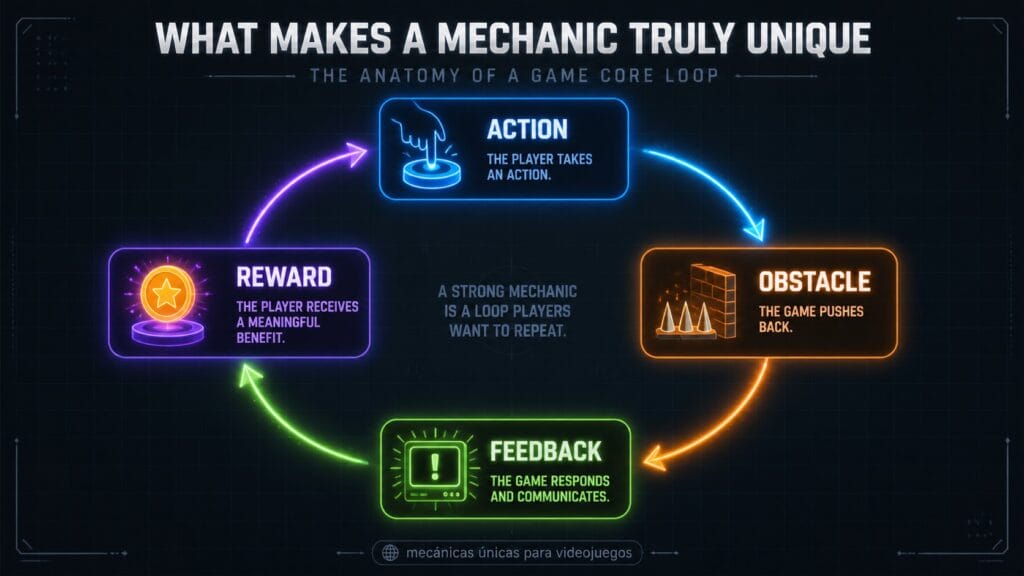
- The core loop is the heartbeat of your game. Every mechanic must feed into a clear loop — Action → Obstacle → Feedback → Reward.
- Playtest relentlessly. Game designer Tracy Fullerton calls playtesting “the most important activity a designer engages in.”
What Makes a Mechanic Truly “Unique”?
A game mechanic is not just a button you press or a rule you follow. It is the language through which a player speaks to the game world — and the game world speaks back. The Spanish game design educator platform Tokio School defines it precisely: “Las mecánicas de juego describen lo que un jugador puede hacer, cómo lo hace y las reglas que gobiernan esas acciones.” (Game mechanics describe what a player can do, how they do it, and the rules that govern those actions.)
For a mechanic to be genuinely unique, it needs to satisfy four criteria identified by KokuTech’s game design research:
- Fresh Perspective — it offers a new way to interact with the game world, whether through an unusual control scheme, an innovative loop, or a novel problem-solving framework.
- Simple Yet Deep — players grasp the basics within seconds but discover layers of complexity over hours of play.
- Memorable Experience — the mechanic creates moments players will describe to their friends.
- Purposeful Innovation — it is not different for the sake of being different; it enhances the game’s core experience in a meaningful, deliberate way.
The Difference Between a Feature and a Mechanic
This is a distinction many aspiring developers miss. A feature is something your game has. A mechanic is something your game does — it is an active interaction system with cause and effect. Rolling dice in a board game is not a mechanic; the uncertainty it generates is. Jumping in a platformer is not a mechanic; the spatial challenge that jump creates is. When Jonathan Blow designed Braid, he was not simply adding a rewind button — he was creating a multidimensional space of interactions where every game object had a unique relationship with time, generating emergent narrative meaning from pure gameplay.
The Psychology Behind Engaging Mechanics: Flow State
Understanding why certain mechanics captivate players requires knowing Mihaly Csikszentmihalyi’s Flow Theory. Flow is “a state of complete and energetic focus on an activity, accompanied by a high level of enjoyment and satisfaction.” In game design terms, a player enters flow when the challenge presented by your mechanic precisely matches their current skill level — not so hard they feel anxious, not so easy they become bored.
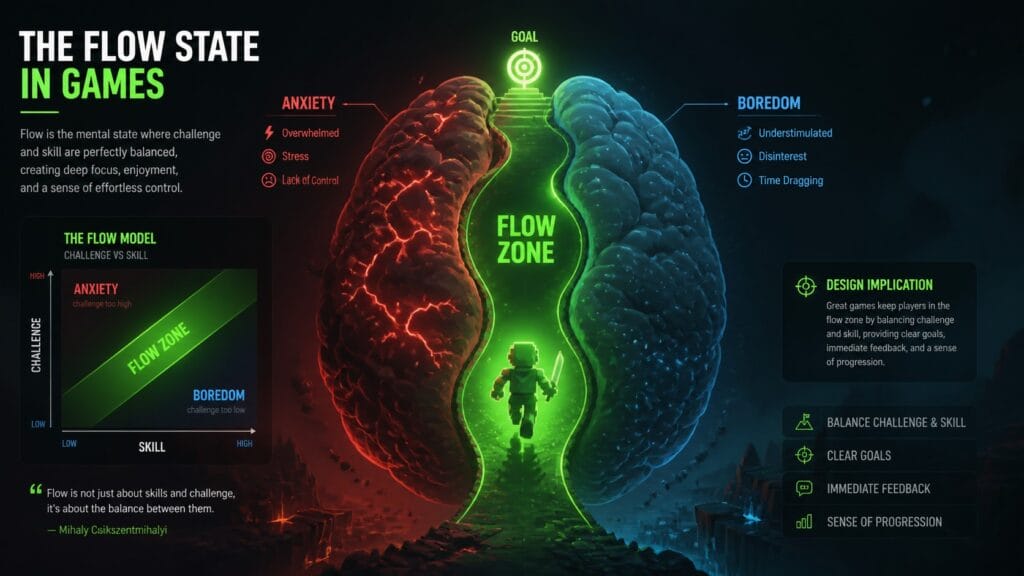
Scientific research published by the National Institutes of Health confirms that video games are among the most effective tools for inducing flow states, and that “keeping players in this state is considered to be one of the central goals of game design.” A unique mechanic contributes to flow when it provides:
- Clear goals — the player always knows what they are trying to do
- Immediate feedback — every action has a visible, meaningful consequence
- Challenge-skill balance — difficulty scales with the player’s growing competence
- A sense of personal control — players feel their choices matter
The core gameplay loop is the engine that sustains flow. As game design educator Anton Slashcev summarizes, a great core loop follows: Action → Obstacle → Feedback → Reward → Upgrade → repeat. Each iteration of the loop should feel slightly different, richer, and more rewarding than the last.
The 5-Step Framework: How to Design Unique Game Mechanics
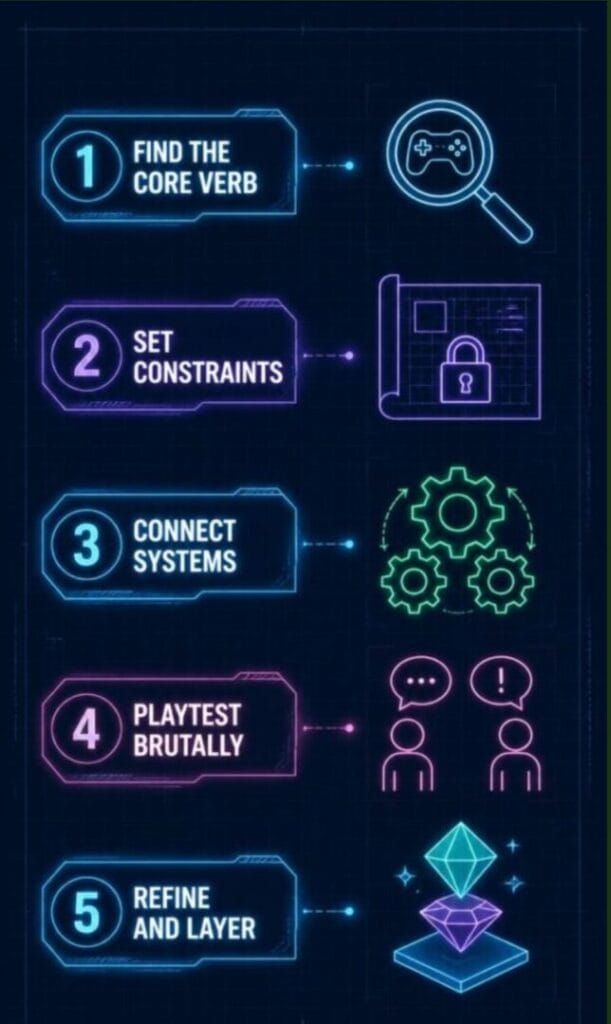
This framework synthesizes best practices from game designers, developers, and researchers:
Step 1 — Find Your Core Verb
Every iconic mechanic can be reduced to a single, active verb. Super Mario Odyssey: capture. Celeste: dash. SUPERHOT: freeze (time). Portal: tunnel. Baba Is You: rewrite (rules). Ask yourself: what is the one thing a player will do thousands of times in my game? That verb should feel tactile, replayable, and intrinsically satisfying — before any rewards are added.
A Reddit game design thread offers deceptively simple advice: “Instead of coming up with mechanics from the start, begin by asking what feeling you want to create in the player.” Start with the emotion, reverse-engineer the interaction.
Step 2 — Impose Constraints
Constraints are the most underrated tool in a designer’s kit. Eduard Bonnin, creative director and game designer at Wandersky, designed his entire game around a single constraint: one arrow. That arrow can be launched, recalled, manipulated mid-flight, used to push enemies, activate switches, and solve puzzles — creating what developers call “una flecha, infinitas posibilidades” (one arrow, infinite possibilities). The constraint did not limit the game; it defined it.
Lucas Pope started Return of the Obra Dinn not with a story, but with a visual constraint: a 1-bit black-and-white 3D rendering style inspired by childhood Macintosh games. The limitation forced him to develop a deduction system that became the game’s core identity.
Step 3 — Connect Your Mechanic to Multiple Systems
A mechanic gains depth when it intersects with other game systems. Systems thinking encourages developers to see their game as “a web of connected parts rather than isolated rules” — when players harvest resources, it affects the environment; when they solve a puzzle, it changes social dynamics. Ask: does my core mechanic interact with combat? With exploration? With narrative?
In Wandersky, the single-arrow mechanic does not just affect combat — it is also the puzzle-solving tool and the progression gateway. In Hollow Knight, the nail (sword) mechanic governs not only fighting but also pogo-jumping across hazards, a design decision by Team Cherry that emerged during development and became a celebrated secret depth layer.
Step 4 — Playtest Ruthlessly (and Early)
Pre-release experimentation research from arXiv confirms that “continuously testing and experimenting with new ideas and features is essential in validating and guiding development toward market viability.” Playtesting is not a final-stage quality check — it is the primary design tool.
Designer Tracy Fullerton calls playtesting “the most important activity a designer engages in, while it’s often the one designers understand the least about.” The rule is simple: do not speak — observe. When players struggle somewhere unexpected, take note and redesign; when they smile and abuse a mechanic you didn’t intend, lean in and let them.
Step 5 — Layer Complexity Gradually
Celeste’s lead developer Maddy Thorson described her approach at GDC 2017: every level must be designed as a mini-story — a beginning (introduce the mechanic), tension (challenge the player), climax (the hardest application), and resolution (a reward). This layered complexity keeps players in the flow zone as their skill grows. Thorson insisted on multiple solutions for every level, ensuring that different play styles were accommodated without compromising the core dash mechanic.
Real Stories From Developers: Where Unique Mechanics Are Born
Piotr Iwanicki & SUPERHOT: Seven Days That Changed FPS Games
In August 2013, Polish developer Piotr Iwanicki submitted a game to the 7 Day FPS Challenge — a game jam. The concept was brutally simple: “Time moves only when you do.” SUPERHOT went viral within days. What Iwanicki had stumbled on was not a gimmick; it was a genre-defining constraint that transformed a first-person shooter into a real-time strategy puzzle. By making time a function of the player’s movement, every level became a frozen diorama waiting to be analyzed, then executed.
The full game launched in 2016 after years of iteration, but the core mechanic was intact from day one. The lesson: sometimes a unique mechanic is born in a single weekend — but it takes years of iteration to reach its full potential.
Arvi “Hempuli” Teikari & Baba Is You: Rewriting the Rules
Arvi Teikari is a Finnish solo developer who created Baba Is You as a Nordic Game Jam entry. The central idea — that the rules of the game themselves are objects you can push and rearrange — grew from a deceptively simple question: “What if the ruleset wasn’t fixed?” Push the word “WALL” away from “IS STOP,” and suddenly walls are passable. Push “BABA” to connect with “IS WIN,” and you win instantly.
Teikari spent years refining the mechanic from the jam prototype into a 200-level puzzle game that won multiple Game of the Year awards. The secret to its success: intense focus on a single mechanic, which allowed him to explore its full depth rather than adding systems.
Lucas Pope & Return of the Obra Dinn: Starting With a Constraint
After Papers, Please, Lucas Pope wanted to make a purely visual-first game. He started with a 1-bit rendering engine and no story. As he built the visual system, the mechanic of “figuring out how 60 people on a ship died” emerged organically from the constraints of what his engine could show. The notebook system — allowing players to cross-reference clues, names, and causes of death — arrived very late in development, solving a scalability problem he had not anticipated in the original demo.
Pope’s key insight: “If there’s no problem, then I’m not that interested. But if there’s a restriction or some limitation, then I’m interested suddenly.” Constraints do not block creativity — they are creativity.
Maddy Thorson & Celeste: A Weekend Prototype That Became a Cultural Moment
Celeste was created in a single weekend in August 2015 when Maddy Thorson and Noel Berry built a PICO-8 prototype during a game jam. The dash mechanic — a short directional burst that defines every movement in the game — was inspired in part by bouldering, where each move requires full commitment and precise timing. Thorson later said the mechanic needed to “mirror the feeling of climbing” — a purposeful emotional anchor that connected the mechanic to the story of a young woman battling anxiety.
The result was a game where the mechanics were the narrative: every failed jump was a reflection of self-doubt, and every successful dash was a small act of courage.
Use Cases and Examples by Genre
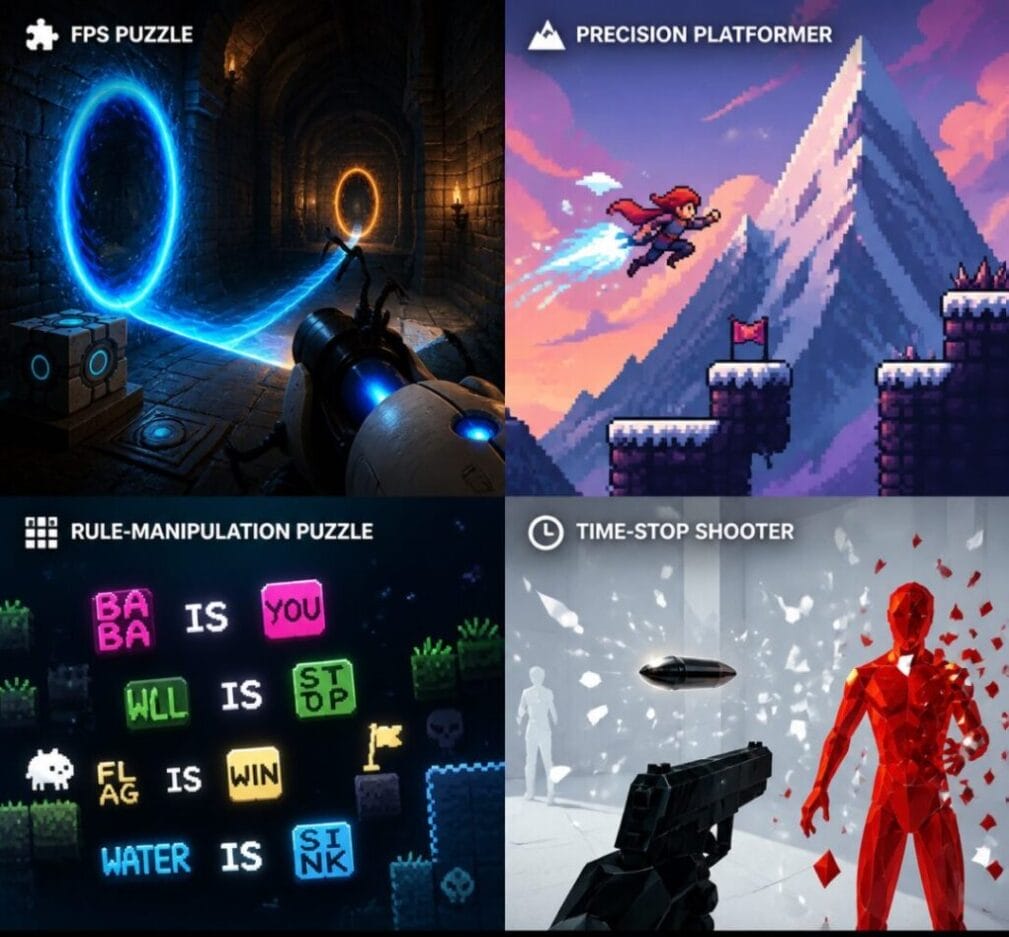
The following table maps mechanic types to game genres, real examples, and the design principles behind them:
| Genre | Unique Mechanic | Game Example | Design Principle |
|---|---|---|---|
| FPS / Puzzle | Portal traversal | Portal (2007) | Environment interaction — altering physics |
| Platformer | Coyote-time dash | Celeste (2018) | Simple verb, emotional layering |
| FPS | Time-freeze on stillness | SUPERHOT (2016) | Constraint-driven genre subversion |
| Puzzle | Rewritable game rules | Baba Is You (2019) | Meta-mechanic — the rules ARE objects |
| Action-Adventure | Single-arrow multi-use | Wandersky (TBD) | One-tool infinite possibilities |
| Mystery | Deduction-from-death | Return of the Obra Dinn (2018) | Narrative mechanic — identity as puzzle |
| Metroidvania | Enemy soul absorption | Hollow Knight (2017) | Mechanic-as-worldbuilding |
| Roguelite | Procedural time loops | Hades (2020) | Loop as narrative engine |
Innovative Mechanics in the 2024 Indie Scene
The indie game scene in 2024 continued to push mechanic-first design. Wardrome’s analysis of 2024’s breakout titles identified several trends:
- Language-as-mechanic: Lok Digital integrated constructed language learning directly into puzzle solving, making cognitive engagement inseparable from entertainment.
- Time as a tool for player agency: Multiple 2024 titles used time-rewind not as a gimmick but as “a tool to teach players to learn from mistakes” — reducing frustration while preserving challenge.
- Genre-blending: Crescent County fused street racing with magical witch abilities, showing how thematic integration can revitalize worn-out mechanics.
Common Mistakes That Kill Unique Mechanics
Even the strongest mechanic idea can fail during development. These are the patterns most frequently observed:
❌ Mistake 1: Feature Creep
Adding more mechanics to compensate for a weak core mechanic only dilutes the experience. Final Boss Blues’ game identity framework puts it bluntly: “If you need your game to stand out, don’t load it with every feature you can think of. That approach will only water down the elements that make it truly unique.” Cut anything that does not serve the core verb or its goals.
❌ Mistake 2: Designing in Isolation
Mechanics that are never seen by outside eyes before shipping often have critical blind spots. ArXiv research on indie game experimentation found that resource constraints force many indie developers to skip structured playtesting — a shortcut that frequently causes post-launch problems. Playtest with people who are not friends. Cold observers are the most honest testers.
❌ Mistake 3: Ignoring the Emotional Contract
Jonathan Blow’s core philosophy — articulated in his GDC Designing Game Mechanics talk — is that mechanics must fill a dimensional space of interactions, not just execute a single action. Every mechanic makes an implicit promise to the player about what the game feels like. Breaking that promise — even once — erodes trust.
❌ Mistake 4: Complexity Before Fun
Anton Slashcev’s 5-step core gameplay framework stresses a critical rule: “Fun is king — boring actions can’t be fixed by adding systems on top.” Make the core verb feel good before building anything else around it. A mechanic that players enjoy with no context — no rewards, no story — is a mechanic worth building a game around.
Tools and Resources for Designing Your Mechanics
Here are the tools and references that professional and indie developers use to design, document, and test their mechanics:
Game Design Document (GDD)
A Game Design Document is not optional — it is the blueprint that aligns your entire team around the core mechanic. Key sections include:
- Core Loop: the cycle of actions at the heart of the game
- Primary Mechanics: the core verb and its direct interactions
- Secondary Mechanics: supporting systems that enhance the core
- Difficulty Progression: how the mechanic scales with player skill
- Emotional Pillar: what feeling the mechanic should produce
Rapid Prototyping Tools
| Tool | Best For | Why Developers Use It |
|---|---|---|
| PICO-8 | Rapid 2D prototyping | Celeste started here in 48 hours |
| Unity | Full 3D/2D mechanics testing | Industry standard for indie devs |
| Godot | Open-source flexibility | Growing indie community |
| Paper prototyping | Mechanical logic testing | Fastest feedback loop possible |
| GDevelop | No-code mechanic testing | Accessible for early ideation |
Recommended Reading and Learning
- Game Design Vocabulary by Keith Burgun — foundational principles of gameplay design
- Designing Your Game Mechanics Based on Player Types (UX Design) — applying Bartle’s taxonomy to mechanics
- Level Design Workshop: Designing Celeste (GDC 2017) — Maddy Thorson’s full talk on layered mechanics
- Jonathan Blow on Designing Game Mechanics — a philosophical deep-dive into interactive space
- Finding Fun Series by KokuTech — question-driven mechanic design guides
Conclusion: Your Mechanic IS Your Game
The greatest video games of the last decade were not the most visually spectacular or the most narratively complex. They were the ones where a single, well-thought-out mechanic became the lens through which every other element of the game was experienced. SUPERHOT is a philosophy about decision-making disguised as a shooter. Celeste is a story about anxiety disguised as a platformer. Baba Is You is a question about the nature of rules disguised as a puzzle game.
When you design a unique mechanic for your video game, you are not just designing an interaction — you are designing a feeling, a perspective, and ultimately an identity that players will carry with them long after the credits roll. Start with one verb. Constrain it. Connect it. Test it. Layer it. Then trust it.
The mechanic is the message.
❓ FAQ: Cómo Crear Mecánicas Únicas para Videojuegos
Q1: What is a game mechanic, exactly?
A game mechanic is the set of rules and interactions that define what a player can do in a game and what the game does in response. It is the combination of procedures and rules that govern every player action. It is distinct from a feature (which is passive) — a mechanic is always active: it responds, challenges, and rewards.
Q2: How do I come up with a truly unique mechanic?
Start by identifying the emotional experience you want to create, then work backwards to a core verb. From there, impose constraints that force creative solutions. Study existing games not to copy but to identify what they leave unexplored. Many landmark mechanics emerged from game jams — limited time and limited tools are features, not bugs.
Q3: How do I know if my mechanic is good enough?
Put it in front of five people who have never seen your game. Give them zero instructions. Observe. If they naturally discover the mechanic and start smiling, experimenting, or asking questions — you have something. If they stare blankly or get frustrated immediately, the mechanic needs iteration before anything else is built around it.
Q4: Can a single mechanic really carry a whole game?
Yes — and the greatest indie games prove it. SUPERHOT, Baba Is You, and Return of the Obra Dinn are all built around one central mechanical idea, executed with extraordinary depth and precision. A focused mechanic explored fully is almost always more compelling than ten shallow mechanics stacked together.
Q5: What is the biggest mistake developers make with game mechanics?
Feature creep — adding more systems to fix a broken or boring core mechanic. If the fundamental verb does not feel good on its own, no amount of progression systems, narrative, or visual polish will save it. Always validate the core loop first.
Q6: How does the Flow State theory apply to mechanic design?
Mihaly Csikszentmihalyi’s Flow Theory tells us that players enter a state of deep engagement when challenge and skill are in perfect balance. A well-designed unique mechanic naturally creates this balance by starting simple and layering complexity as the player’s competence grows — keeping them perpetually at the edge of their ability, never bored, never overwhelmed.
Q7: What tools should I use to prototype a new mechanic?
Start on paper — draw the interaction, map cause and effect. Then move to a rapid prototyping environment like PICO-8 (Celeste used this) or a simple Unity/Godot project. The goal is to test the feel of the mechanic as early as possible, before any art, story, or systems are attached.
Enjoyed this guide? Share it with your team and follow for more game design deep-dives. What is your game’s core mechanic? Drop it in the comments below.

Game Developer | Designer | Creative Storyteller
Matt Dogherby is a passionate game developer and designer based in Brisbane, Australia. With a career spanning over 15 years, Matt combines technical skill with a deep love for storytelling to create games that captivate and inspire. His unique perspective is shaped by the laid-back energy of Brisbane and his lifelong connection to the ocean, where he often trades coding sessions for surf sessions.


