
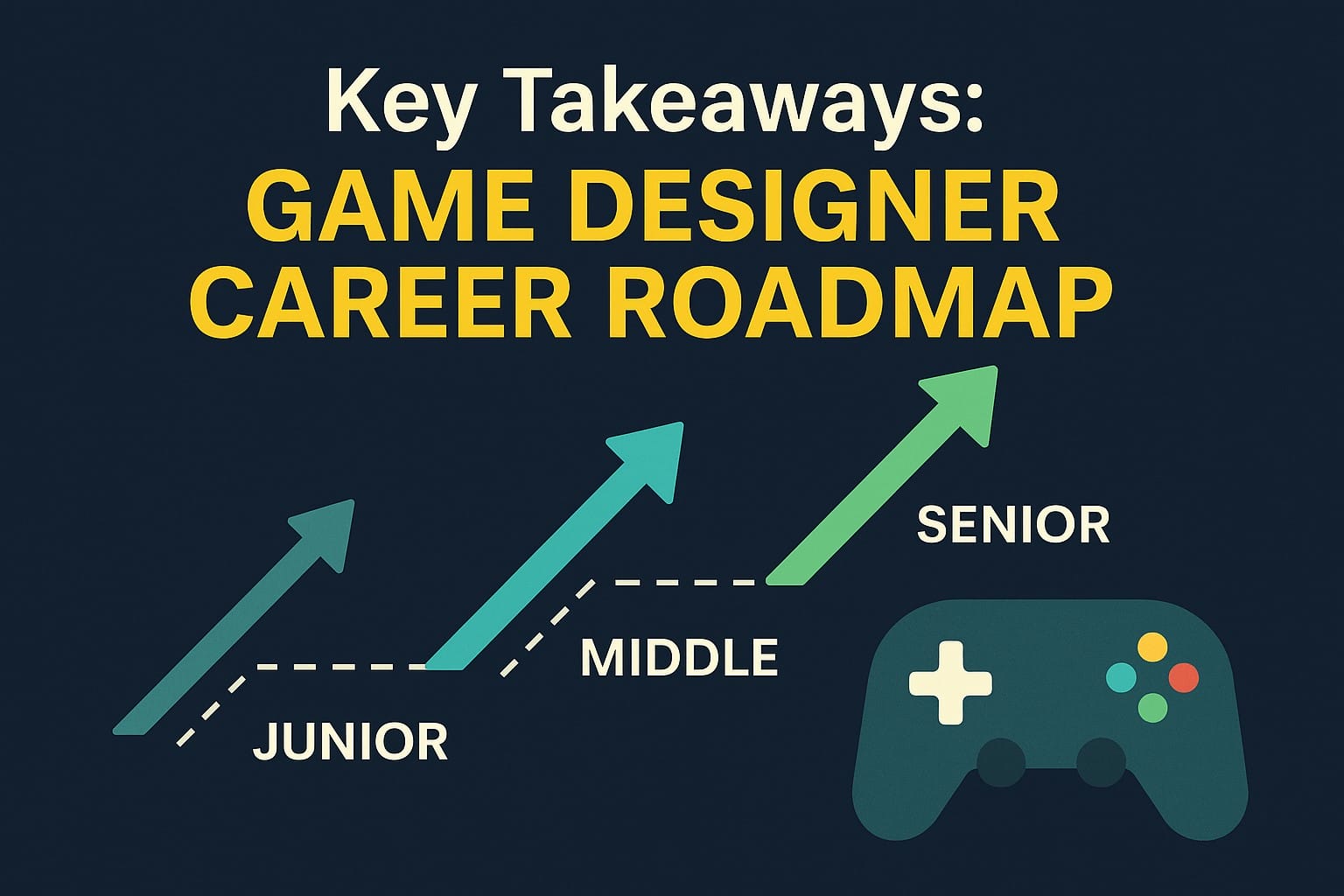
Key Takeaways game designer career roadmap
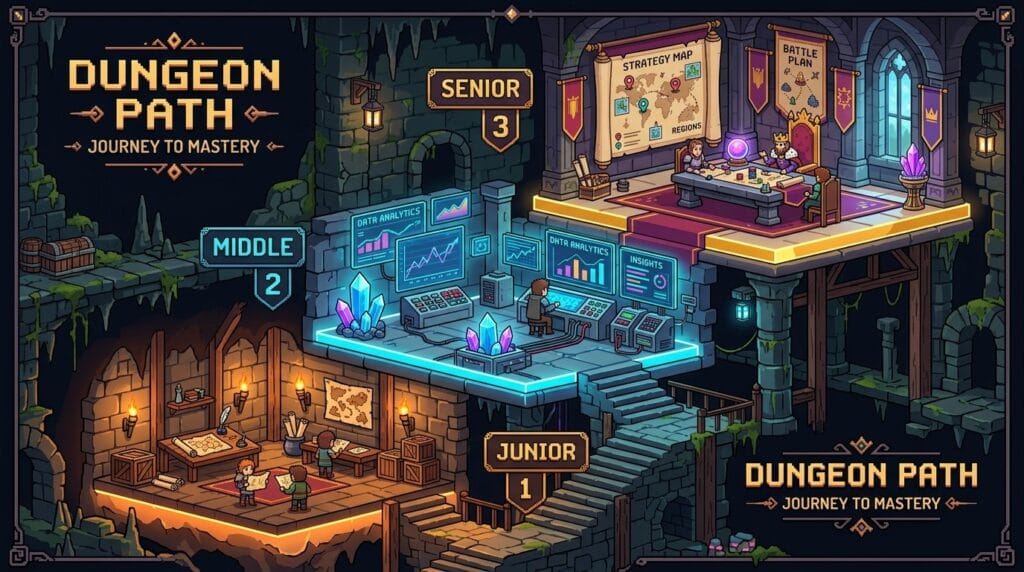
- Game design is a structured career journey through three core levels: Junior, Middle, and Senior, each requiring a distinct set of hard and soft skills.
- Junior designers focus on gameplay fundamentals, documentation, and collaboration; Middle designers shift to analytics, UX, and system design; Senior designers lead strategy, monetization, and cross-functional teams.
- The global video game market reached $298.98 billion in 2024 and is projected to reach $600.74 billion by 2030, making game design one of the most in-demand creative-technical careers of the decade.[1]
- Senior game designers can earn upwards of $111,000–$126,000 per year, with management roles often exceeding $150,000.[2]
- Leveling up is not just about skills — it’s about expanding your impact radius: from individual tasks to team direction to business outcomes.
Introduction: Game Design Isn’t Just a Job Title
Game designer isn’t just a job title — it’s a progression. A living, leveling story arc that mirrors the very games you create. Most people entering the industry imagine themselves behind the wheel of the next Elden Ring or The Legend of Zelda the moment they graduate. The reality is far richer, and far more nuanced.
Every great senior designer started by playtesting someone else’s levels. Every lead who now defines product vision once spent weeks adjusting a single difficulty curve. That’s not a disappointment — it’s the foundation.
This article maps that full journey, level by level: what skills you need, what impact looks like at each stage, what real salaries look like, and how to accelerate through each tier. Whether you’re just starting out or engineering your next promotion, this is the path.
The complete Game Designer Levels framework, from Junior to Senior — each tier builds on the one before.
The State of the Game Design Industry in 2026
Before we explore the levels, let’s understand why this career path matters more than ever. The global video game market was valued at $298.98 billion in 2024 and is forecast to grow at a 12.2% compound annual growth rate through 2030, reaching an estimated $600.74 billion. Mobile gaming leads with over 52% of 2025 revenues, while cloud gaming is projected to grow at a staggering 43.20% CAGR through 2031.[3][2][1]
This isn’t a niche creative career anymore. Game designers today work at the intersection of psychology, data science, product management, and storytelling — and the industry rewards those who grow into that hybrid profile. The U.S. Bureau of Labor Statistics reports a median annual wage of $99,800 for the occupational category including game designers, and the International Game Developers Association found that 22% of professionals now earn $150,000 or more annually.[2]
The catch? Reaching those numbers demands a deliberate, structured development journey. That journey has three levels.
Level 1: Junior Game Designer — Learning How Games Feel
What the Junior Level Is Really About
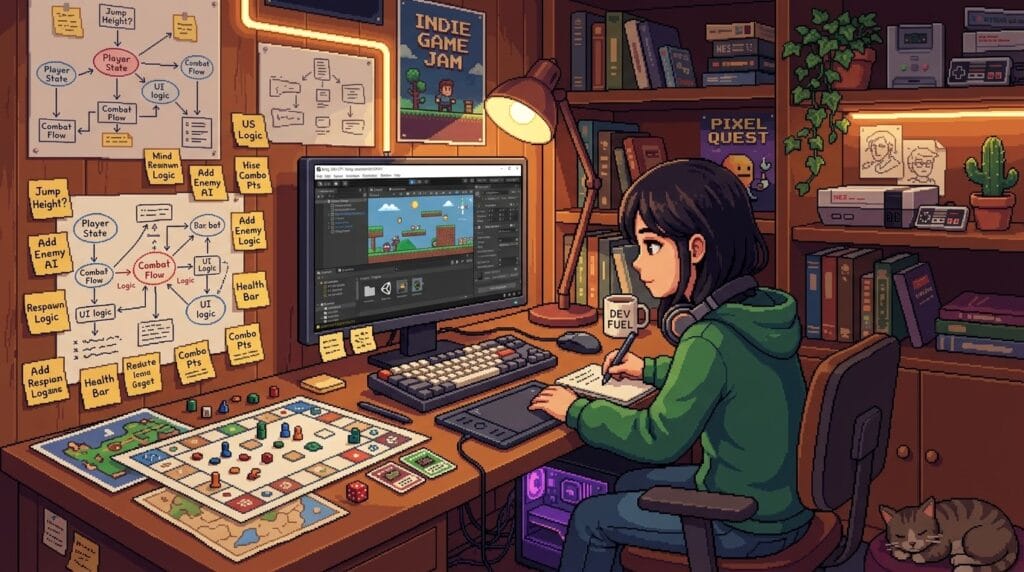
The Junior level is where you develop gameplay intuition. Your primary mission is not to design blockbuster systems — it’s to deeply understand how game systems work, and to learn how to translate ideas into communicable, buildable designs. In 2026, a typical junior designer’s day involves prototyping mechanics in Unity or Unreal, writing and maintaining design documents, supporting level balancing, and playtesting.[4]
Think of it as learning a new language — except the language is “systems thinking,” and every game you play is a vocabulary lesson.
Core Skill: Gameplay Literacy
The most underrated skill at the Junior level is playing widely and analytically. Not just playing games you enjoy — playing games outside your comfort zone and deconstructing why they feel the way they feel. What is the reward loop in Candy Crush? Why does Dark Souls feel punishing but not unfair? How does Fortnite pace its tension toward the final circle?
Gameplay literacy means understanding loops, pacing, and mechanics not as abstract concepts but as felt experiences. A junior who can articulate why a particular enemy placement creates tension — not just that it “feels hard” — is already thinking like a designer.[5]
Personal experience insight: Many junior designers fall into the trap of designing what they want to play rather than what their players need. The fastest way to overcome this is to run your first playtests with people outside your immediate circle — friends who aren’t game-literate, family members, coworkers from other departments. Their confusion will teach you more than any design textbook.
Core Skill: Documentation
Good ideas mean nothing if they can’t be communicated. At the Junior level, you’ll write Game Design Documents (GDDs), flowcharts, and specs that translate design intent into something artists and engineers can act on. The skill isn’t writing more — it’s writing clearly.[4]
Writing clear game design specs is a professional superpower that gets you noticed early. A one-page spec that covers the mechanic, its inputs and outputs, edge cases, and visual placeholders will consistently outperform a 20-page document that buries the lead.[4]
Core Skill: Prototyping
Build early, break often. The Junior level is the best time to develop a healthy relationship with failure. Whether you’re using paper prototypes, cardboard game boards, or a basic Unity scene, the goal of prototyping is to answer a design question cheaply before investing in full production.[6]
A junior designer I know spent three days building a paper version of a battle economy system before a single line of code was written. It saved six weeks of development when a core assumption turned out to be wrong. The lesson: prototyping is not a phase — it’s a mindset.[6]
Core Skill: Basic Balancing & Collaboration
Tweaking difficulty curves and setting reward cadences sounds unglamorous. It is also completely essential. The difference between a game that feels fair-but-challenging and one that feels punishing-or-trivial often comes down to a single adjustment to an enemy’s health pool or a 15% change in XP reward scaling.
Equally important is learning to collaborate cross-functionally. At the Junior level, your designs exist inside a machine built by artists, engineers, producers, and QA testers. Learning to share design intent clearly — and to receive feedback graciously — is not a soft skill. It’s a career-defining one.[7]
Junior Salary Range
Entry-level game designers in the US earn an average of $62,000 per year, with top earners in premium markets reaching $76,000. Those with 1–3 years of experience typically reach $66,000–$72,000 according to Glassdoor’s 2025 data.[8][2][9]
the first subsection.
Level 2: Middle Game Designer — Where Impact Multiplies
The Shift in Mindset
The transition from Junior to Middle is one of the most significant cognitive leaps in any creative-technical career. At the Junior level, you execute tasks. At the Middle level, you own outcomes. The question changes from “Did I complete this?” to “Did this work?” — and answering that question requires data.[10]
According to devtodev’s research on senior and lead designers, a mid-level game designer has to be able to “do everything” — the diverse knowledge base acquired as a junior becomes the fuel for cross-functional contribution at the middle tier.[10]
Core Skill: Analytics Deep-Dive
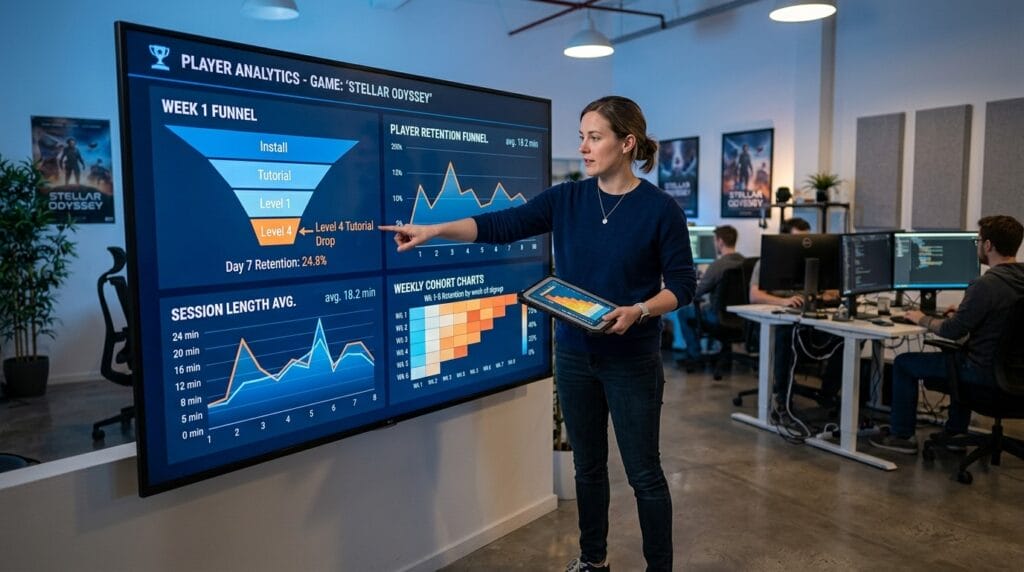
The Middle level is where design meets data science. You’re now expected to query funnel data, cohort analyses, and retention metrics — typically using SQL, Excel, or analytics tools like Looker or Amplitude — and use those insights to drive design decisions.[3]
Use case: A Mobile RPG team was seeing a drop-off at the 72-hour mark in player sessions. The middle designer pulled cohort data, identified that the drop correlated with the third boss difficulty spike, A/B tested two tuning variants, and increased D7 retention by 11%. That’s the analytics loop in action: observe, hypothesize, test, iterate.
Learning SQL for game analytics is one of the highest-ROI investments a mid-career designer can make. It removes the dependency on a data team and gives you direct access to player behavior.[11]
Core Skill: UX / UI Excellence
At the Middle level, UX goes beyond “make it pretty.” It means co-creating intuitive player flows grounded in player psychology models — understanding why players make the decisions they do, and designing systems that reduce friction without removing challenge.[12]
Key principles of game UX excellence at this level include:[13][14]
- Visual hierarchy — guide the player’s eye without explaining what to do
- Feedback and microinteractions — every action should have an immediate, satisfying response
- Accessibility best practices — colorblind modes, adjustable text sizes, input remapping
- Wireframe and usability testing — test assumptions before they become production assets
A 20% reduction in “back button confusion” was documented in one mobile multiplayer redesign simply by standardizing icon styles and positioning across screens. Small UX decisions compound into massive player experience improvements.[14]
Core Skill: System Design
System design is the architecture work of game design — building the economies, progression loops, and interconnected mechanics that give a game its long-term structure. At the Middle level, you’re designing systems that need to hold up across a player’s 50-hour journey, not just their first 30 minutes.
System design for games involves designing progression trees, currency economies, and difficulty scaling frameworks — and then measuring their effectiveness against KPIs like average session length, monetization conversion rates, and feature engagement. A designer who can build a system and instrument its measurement is rare and extremely valuable.[10]
Core Skill: Production Awareness & Mentoring
Middle designers need production fluency — understanding scope, technical limitations, and live-ops constraints. When a middle designer suggests a feature, they should already know whether engineering has bandwidth, whether it creates asset debt, and whether it can be hot-patched in a live title.[7]
Mentoring junior designers is also a Middle-level responsibility, not a Senior-level one. According to a 2020 study by the Design Management Institute, designers who received regular mentoring sessions experienced a 25% increase in productivity. Sharing your tools, reviewing junior work, and helping others develop their design eye is one of the fastest ways to demonstrate Senior-level readiness.[15][16]
Middle Designer Salary Range
Mid-career professionals with 2–4 years of experience earn an average of $83,000 annually, while those with 5–8 years reach $99,000. Glassdoor’s data shows the $82,000–$92,000 band for designers with 4–9 years of experience.[2][9]
Level 3: Senior Game Designer — Shaping Games, Teams, and the Future
What Senior Really Means
Senior designers don’t just design games better. They define what the game is, align that vision with business reality, lead the people who build it, and represent the craft to the broader industry. The skills shift dramatically from craft to leadership — from “how does this mechanic work?” to “why does this product exist and where is it going?”[10][17]
According to devtodev’s analysis, the senior designer’s skillset moves away from hard technical skills toward people-oriented competencies: structuring information, presenting ideas with conviction, thinking at product scale, and compromising intelligently.[10]
Core Skill: Vision & Pillars
The senior designer’s most essential output is a clear, communicable product vision. This means defining the game’s core experience, its design pillars (the non-negotiable values that every feature decision must serve), and aligning that vision with business objectives.
Design pillars are not marketing bullets. They’re decision filters. When the team debates whether to add feature X, the pillars answer: “Does this serve our core promise to players? Does it fit our monetization model without compromising retention? Does it fit our timeline?” A well-crafted vision document becomes the product’s constitution.[7][5]
Use case: Imagine a mobile strategy game with three pillars: Accessible Depth, Meaningful Choice, Social Connection. Every feature pitch — from alliance systems to battle pass design — gets evaluated against these three lenses. This prevents feature bloat and keeps the team aligned without micromanagement.
Core Skill: Business & P&L Literacy
Senior designers need to speak the language of the boardroom. That means understanding Return on Investment forecasting, monetization models, and P&L trade-offs — and being able to explain design decisions in those terms to executives and stakeholders.[2]
Live-service monetization is a defining skill for modern senior designers. Free-to-play held 43% of adoption in 2025, and subscription models are growing at 22.85% CAGR. Understanding IAP (In-App Purchase) optimization, IAA (In-App Advertising) balance, and the ethics of engagement mechanics is not optional — it’s a core competency.[3]
This is also where senior designers must navigate one of the profession’s hardest tensions: designing for player delight and sustainable revenue. The best senior designers articulate why these goals are more complementary than they are contradictory.
Core Skill: Live-Ops Leadership
Modern games are services, not shipped products. Senior designers lead live-ops calendars, seasonal content strategies, A/B testing pipelines, crisis responses (when a patch breaks a core system), and monetization tuning.[2]
Live-ops leadership requires rapid decision-making under uncertainty. When a new content drop causes unexpected player frustration, a senior designer needs to diagnose the root cause, propose a fix, communicate to the team and stakeholders, and oversee the rollout — all within hours.[10]
Core Skill: Cross-Functional Leadership & Team Development
The senior designer owns the product roadmap across disciplines. They present to executives, negotiate scope with production, align art direction with design intent, and champion the player’s perspective in every room they enter.[17]
Equally, senior designers hire and develop talent. Setting scalable design processes — documented workflows, review frameworks, onboarding programs for juniors — is how their impact outlives individual projects. As one lead game designer put it: “The difference between a junior and a senior isn’t skill. It’s that the senior makes everyone around them better.”[7]
Core Skill: Industry Stewardship
The most impactful senior designers give back. Speaking at conferences like GDC (Game Developers Conference), writing post-mortems, contributing to open design discourse — these activities build personal reputation, attract talent, and advance the discipline as a whole.[18]
This isn’t ego. It’s ecosystem investment. The designers who share their failures as openly as their successes — who document what didn’t work and why — create the intellectual infrastructure the next generation of junior designers learns from.[18]
Senior Designer Salary Range
Senior game designers with 8+ years of experience average $111,000–$126,000 per year, with Lead Designer positions regularly surpassing $150,000. The IGDA survey shows 22% of employees at the senior and management tier earn $150,000 or more annually.[2]

The Three-Level Skills Comparison
| Skill Domain | Junior | Middle | Senior |
|---|---|---|---|
| Core Focus | Execution & learning | Ownership & analysis | Vision & leadership |
| Design | Mechanics, loops, pacing | Systems, economies, UX | Pillars, product strategy |
| Data | Basic playtesting | SQL queries, KPI analysis | P&L forecasting, A/B strategy |
| Collaboration | Takes direction | Cross-functional contributor | Roadmap owner, exec presenter |
| People | Works with mentors | Mentors juniors | Hires, develops teams |
| Business | Awareness | Production scope, risks | Monetization, ROI, live-ops |
| Industry | Learning | Contributing | Speaking, stewardship |
| Avg US Salary[2][9] | $62K–$76K | $83K–$99K | $111K–$150K+ |
How Long Does Each Level Take?
Career progression timelines vary significantly by studio size, project scope, and individual drive, but industry patterns provide useful benchmarks:[7][2]
- Junior to Middle: Typically 2–4 years. The signal for readiness is when you’re proactively identifying problems rather than waiting for them to be assigned.
- Middle to Senior: Typically 3–5 additional years. The signal is when your decisions affect multiple team members’ work — and you’ve started building systems, not just features.
- Senior to Lead/Director: Variable, but often requires 8+ total years in the industry plus demonstrated organizational impact.[2]
Progression is not linear. Switching studios, shipping a successful title, or developing a high-impact specialization (like mobile live-ops or AI-driven gameplay) can compress these timelines significantly.[19]
Common Mistakes at Each Level
Understanding what not to do is as valuable as knowing what to pursue:
Junior mistakes:
- Designing for yourself instead of your players
- Over-documenting ideas instead of testing them
- Avoiding hard conversations with engineers or artists about feasibility
Middle mistakes:
- Staying purely craft-focused and ignoring business metrics
- Under-investing in mentoring (thinking it’s “not your job yet”)
- Becoming a solo operator instead of a multiplier[10]
Senior mistakes:
- Designing by committee and losing product vision clarity
- Refusing to compromise on scope — stubbornness disguised as standards
- Neglecting team development in favor of personal creative work[5][10]
The Role of AI in Game Design Career Development
The 2025–2026 wave of generative AI is reshaping what each level looks like in practice. AI tools now assist with NPC dialogue generation, procedural level creation, automated QA, and asset iteration — tasks that previously occupied significant junior designer bandwidth.[11]
This doesn’t eliminate Junior roles. It elevates the baseline expectation. Junior designers now need AI fluency — knowing how to prompt, evaluate, and integrate AI outputs into a design pipeline — as a day-one skill. At the Senior level, leaders must understand the ethical and experiential implications of AI-generated content: what it does to player trust, creative authorship, and studio culture.[20][11]
Personal Experience: The Moment That Defines Each Level
Every designer has a specific memory for each milestone. Here’s how those moments often feel:
The Junior moment: You’re in a playtest, and you watch someone fail at your tutorial for the fifth time. Not because the player is bad — because your instructions weren’t clear. Something shifts. You stop seeing design as invention and start seeing it as communication.
The Middle moment: You pull your first retention dashboard and realize that a feature you spent six weeks on is barely being touched. The data is brutal. But you learn to love it — because now you can fix it.
The Senior moment: A junior designer on your team ships their first feature. Players love it. And you realize your job wasn’t to build that feature — it was to build the designer who built it.
Conclusion: The Path Is the Game
Game design is the rare profession where the work and the metaphor perfectly align. You are always leveling up. Skills, responsibilities, relationships, and impact — all compound over time. The designers who advance most rapidly are not the most talented junior designers. They are the most curious, collaborative, and systems-oriented professionals at every level.
The industry needs designers who can play and analyze, prototype and document, balance and collaborate at the Junior level. It needs designers who can query data, design economies, and mentor peers at the Middle level. And it needs designers who can define vision, speak to business outcomes, and develop the next generation of talent at the Senior level.
The global video game market is projected to more than double to $600 billion by 2030. It will be built, in large part, by the designers who commit to this journey — level by level, skill by skill.[1]
Ready to level up? Here’s how to take action right now:
- If you’re a Junior designer: Pick one game you haven’t played and write a two-page design analysis of its core loop, reward structure, and one thing you’d change. Do this every week.
- If you’re a Middle designer: Pull the analytics for one feature you shipped. Identify one metric that surprised you and design a single-variable A/B test to address it.
- If you’re a Senior designer: Schedule a 30-minute 1:1 this week with a junior on your team. Ask them what they’re confused about. Your answer is this week’s mentoring.
- For everyone: Attend a GDC talk, read one post-mortem per month, and build something — even if it’s a paper prototype — outside of work.
Share this article with someone at a different level than you. The best conversations about career growth happen across levels, not within them.
Frequently Asked Questions
What does a game designer do at the Junior level?
Junior game designers focus on learning the foundations of the craft: playing and analyzing games to build literacy, writing game design documents, building prototypes, adjusting difficulty and reward systems, and collaborating with art and engineering teams. They typically support senior designers rather than owning entire projects.[4]
How long does it take to go from Junior to Senior game designer?
Most designers take 5–9 years to reach the Senior level, with 2–4 years at Junior and 3–5 years at Middle, though this varies significantly based on studio, project scope, and individual development. Working on live-service titles, shipping high-profile projects, or specializing in high-demand areas like mobile monetization can accelerate this timeline.[7][2][19]
What skills are most important for getting promoted from Junior to Middle?
The key transition skills are: learning to query and interpret player analytics data (especially SQL), developing UX research and usability testing capabilities, building an understanding of production scope and technical constraints, and starting to mentor junior colleagues. Designers who move from execution to ownership — proactively identifying and solving problems rather than waiting for direction — signal readiness for the Middle level.[10][17]
How much do game designers earn at each level?
Based on 2025–2026 data: Junior designers average $62,000–$76,000 per year; Mid-level designers average $83,000–$99,000; Senior designers average $111,000–$126,000, with Lead and Director roles exceeding $150,000. Salaries vary significantly by location, studio type, and specialization, with software publishers paying the highest median wages.[2][9]
What is the difference between a Middle and Senior game designer?
Middle designers own features and subsystems, analyze data, design economies, and mentor juniors. Senior designers own product vision and strategy, align design with business and P&L goals, lead cross-functional teams, manage live-ops, and represent the studio to executives and the broader industry. The core shift is from multiplying your own impact (Middle) to multiplying your team’s impact (Senior).[7][10][17]
Do game designers need to know how to code?
Coding is not required, but it is a significant advantage — particularly at the Middle and Senior levels where technical designers who bridge creative and programming capabilities typically earn higher salaries. Knowledge of scripting languages (Lua, Blueprint in Unreal, C# basics in Unity) enables faster prototyping and better communication with engineering.[2][6][4]
What is “industry stewardship” in game design?
Industry stewardship refers to a Senior designer’s role in giving back to the broader game design community: speaking at conferences like GDC, writing post-mortems and design essays, mentoring aspiring designers outside one’s own studio, and contributing to open discourse on design challenges. It builds personal reputation, attracts talent to the studio, and elevates the quality of game design as a discipline.[18]
How is AI changing the game designer career path?
Generative AI is automating several tasks previously handled by Junior designers — NPC dialogue generation, basic level layouts, QA automation — raising the baseline expectation for all levels. Junior designers now need AI fluency as a day-one skill. Senior designers must navigate the ethical and creative implications of AI-generated content on player experience and studio culture.[20][11]
This article is based on industry research, salary data from BLS, Glassdoor, Payscale and IGDA, and analysis of career frameworks from working game designers. All salary figures reflect US market data as of 2025–2026.


